Three shipping quotes land in your inbox. Postal is cheapest. A dedicated line sits in the middle. Express courier costs enough to make you blink.
So, pick the cheapest one, right?
Well, not quite. A shipping quote is only the entrance ticket. It does not tell you how many companies will touch the parcel, how customs will be handled, whether the last mile reaches a PO box, or what happens when tracking goes quiet for four days.
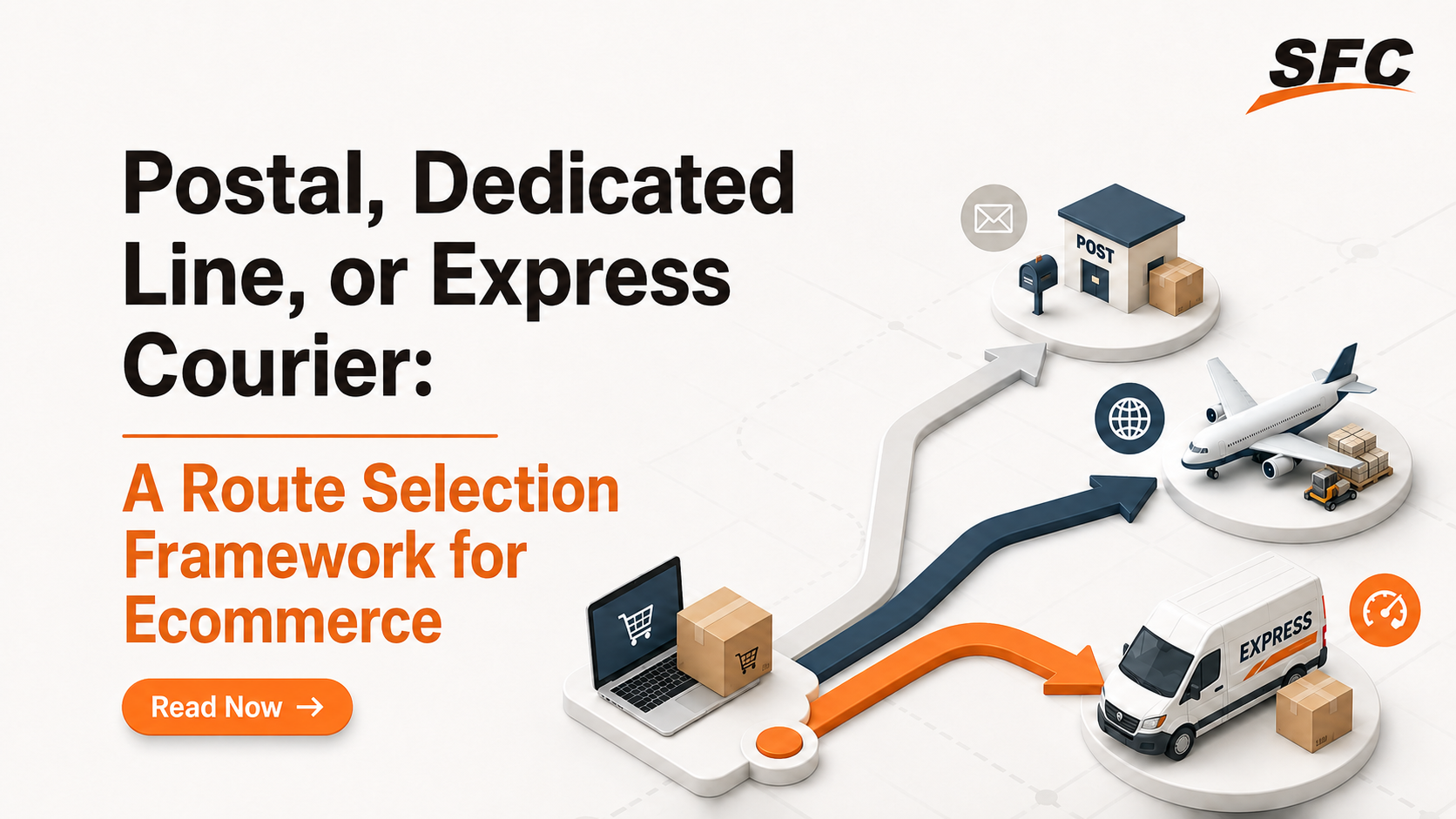
Here is the short answer. Postal shipping usually works best for lightweight, lower-value orders that can accept a flexible delivery window. A dedicated line often gives established ecommerce lanes the best balance of price, speed, tracking, and customs support. Express courier is normally the safer choice for urgent, valuable, replacement, or business-critical shipments.
That is the useful starting point, not the final rule. Product restrictions, destination coverage, customer promise, and total risk can all change the answer. This guide gives you a framework for making that call without turning every order into a logistics meeting.
Postal, Dedicated Line, and Express Courier Are Different Delivery Networks
Sellers often compare route names as if they were three versions of the same service. They are not. The biggest difference is who controls each part of the journey.
How International Postal Shipping Works
Traditional international post connects the postal operator in the origin country with the designated postal operator at the destination. A parcel enters a postal stream, moves through an international exchange, clears customs, and is handed to the destination post for delivery.
Tracking varies. Registered or tracked postal products may provide useful milestones. Economy mail may show only acceptance, departure, destination arrival, and delivery. A low-cost service can also have a long gap between export and the first destination scan. The parcel may be moving during that gap. The customer cannot see it, though, and that is what creates the support ticket.
How a Dedicated Ecommerce Shipping Line Works
A dedicated line, also called a special line or direct line, is built around a particular destination country, region, or product type. It is usually managed by a cross-border logistics provider rather than one national postal operator.
A common route looks like this:
- Parcels are collected from a warehouse or seller in China.
- Orders for the same destination are consolidated at an origin hub.
- The consolidated load moves by contracted air line haul.
- Customs data is submitted before or around arrival.
- Parcels are cleared, separated, and injected into a local postal or commercial delivery network.
- A destination carrier completes the last mile.
The
UPU study on cross-border ecommerce delivery models describes this type of B2B2C chain in much the same way: first-mile collection, consolidation, middle-mile transport, customs clearance, and injection into a postal delivery network. It also highlights what ecommerce shippers increasingly expect, including predictable service, DDP options, delivery choices, and easier returns.
A dedicated line can be quick because it buys transport capacity for a specific lane, while consolidated parcels share the international line-haul cost. Yet several partners may still touch the shipment.
How an Integrated Express Courier Works
Express couriers such as DHL Express, FedEx, and UPS run tightly connected global networks. The courier, or its contracted local operation, controls more of the journey: pickup, hubs, air movement, customs brokerage, tracking events, and final delivery.
Express is designed around speed and visibility. Flights and hub schedules are frequent, customs information is captured early, and exception scans are usually detailed. That control costs money. Rates are also sensitive to dimensional weight, remote-area zones, fuel adjustments, and other surcharges.
|
Route family
|
Best fit
|
Relative cost
|
Speed profile
|
Tracking and control
|
Typical last mile
|
Main weakness
|
|
Postal
|
Light, lower-value, time-flexible parcels
|
Usually low
|
Wider delivery range and more variability
|
Basic to full tracking, depending on product
|
Destination postal operator
|
Quiet scans, slower exceptions, limited claims on some services
|
|
Dedicated line
|
Repeat ecommerce volume on a mature country lane
|
Usually medium
|
Faster and more predictable than basic post
|
End-to-end tracking can be good, but handoffs still matter
|
Local post or commercial parcel carrier
|
Coverage and performance vary by lane and provider
|
|
Express courier
|
Urgent, high-value, replacement, or business-critical orders
|
Usually high
|
Fastest and most time-definite
|
Detailed scans and stronger intervention
|
Integrated or tightly managed courier network
|
High freight cost and multiple possible surcharges
|
These are relative profiles. A premium postal product can beat a weak dedicated line. A discounted express contract can beat an expensive special line for some weight bands. Route selection has to happen at service level, not just category level.
Why a Dedicated Line Is Not Just a Cheaper Express Courier
The word "dedicated" sounds as if one aircraft and one team are waiting for your parcel. Usually, it means the logistics provider has built a repeatable lane using contracted capacity and destination partners.
This distinction explains several common puzzles.
First, the tracking number may change. The origin provider creates one number, while the last-mile carrier creates another. A good system maps both and keeps the tracking page continuous.
Second, a line can perform beautifully to Germany and poorly to Portugal. Departure frequency, customs gateway, local carrier quality, postcode coverage, and parcel volume differ by market. There is no such thing as one global dedicated-line score.
Third, the last mile may be postal even when the route was purchased from a private logistics company. The
USPS international business shipping page explains its Global Direct Entry model: parcels are processed overseas, cleared by US Customs and Border Protection, entered into the USPS mail stream, and then delivered by USPS. That is a clear real-world example of commercial cross-border transport feeding a postal last mile.
Finally, a dedicated line can pause when capacity changes. Ask about dispatch frequency and rollover performance, not just advertised transit time.
Use These Seven Filters Before Comparing Shipping Prices

Price comes later than most sellers think. Start by removing routes that cannot safely, legally, or practically carry the order.
1. Product Eligibility and Shipping Restrictions
Classify the product before creating a label. Common problem categories include lithium batteries, power banks, liquids, perfumes, aerosols, magnets, powders, food, supplements, cosmetics, and products with intellectual-property concerns.
Battery rules deserve special attention. Acceptance can depend on whether the battery is installed in equipment, packed with equipment, or shipped alone. Watt-hour rating, test documentation, packaging, labels, and carrier approval may also apply. The
IATA battery shipping guidance explains that air acceptance depends on battery configuration and rating, and that shippers need to meet identification, packing, marking, labeling, and documentation requirements.
Do not assume that "electronics line" means every battery product is accepted. Ask for the written rule for the exact SKU. An ineligible cheap route is a delayed return wearing a nice price tag.
2. Actual Weight, Chargeable Weight, and Packaging Materials
Record the packed length, width, height, and gross weight. The product dimensions alone are not enough. A phone case in a compact padded mailer behaves very differently from the same phone case inside a large gift box.
Express couriers commonly compare actual weight with dimensional weight and bill the larger result. Dedicated lines may use their own divisor, minimum charge, or size limit. Postal products often have strict maximum dimensions even when the weight is acceptable.
Packaging is part of route selection. A poly mailer can work for apparel, while electronics or glass may need a carton and cushioning. Every parcel also needs a clear, scannable label.
Before approving branded packaging, run the final packed dimensions through a
live shipping cost comparison. A beautiful box that moves the order into a higher chargeable-weight band can quietly eat the margin.
3. Order Value, Gross Margin, and Replacement Exposure
Declared value is only one number. Also consider product cost, selling price, margin, replacement freight, and the cost of disappointing the buyer.
A $15 accessory may tolerate a tracked economy route. A $600 device usually needs stronger tracking, delivery proof, and faster exception handling.
Set internal thresholds. For example, orders above a chosen value may move from postal to dedicated line. A higher threshold may trigger express or manual approval. The exact numbers should reflect your margins and claim history, not a generic blog rule.
4. Destination Country, Postcode, and Address Type
Country-level coverage is not enough. Check the postcode.
An express courier may add a remote-area surcharge. A commercial carrier may not serve islands, military addresses, or PO boxes. National post may reach them, but more slowly.
Address validation is useful here. Standardize the postcode, state or province, phone number, and building details before label creation. An express upgrade cannot rescue a parcel sent to the wrong apartment.
5. Customer Delivery Promise
Do not confuse carrier transit time with the delivery promise shown at checkout.
The customer clock includes fulfillment, carrier collection, export, line haul, customs, last mile, and weekends. A five-to-eight-day route can still create a ten-day customer experience if the warehouse misses Friday's cutoff.
6. Customs Model, Duties, and Taxes
Route names do not guarantee a customs term. A dedicated line can be DDP, DAP, or structured differently. Express can be billed to the sender, receiver, or a third-party account. Postal imports may require the recipient to pay before or at delivery.
Confirm five things:
- who acts as importer of record;
- whether duties and taxes are prepaid;
- what value and currency appear in the customs data;
- which HS code and item description are used;
- what happens if customs asks for documents.
DDP can produce a smoother buyer experience, but only when declarations and tax handling are compliant. The guide to
DDP shipping from China explains the responsibilities behind the term.
7. Tracking, Claims, Support, and Returns
Ask what the buyer will see, not just what the logistics provider can see internally.
Useful tracking should cover acceptance, departure, destination arrival, customs release, last-mile handoff, out-for-delivery, and delivery. Also check whether the last-mile tracking number is mapped automatically. If a customer needs help, your team should not have to search three carrier websites.
Also compare claim deadlines, proof requirements, compensation caps, and return behavior. Does an undeliverable parcel return to China, enter a local return center, or get destroyed?
|
Decision filter
|
Question to ask
|
Warning sign
|
Route action
|
|
Product
|
Is this exact SKU accepted in its packed configuration?
|
Verbal approval with no written rule
|
Remove the route or request compliance review
|
|
Parcel
|
What are the billed weight and size limits?
|
Quote uses product weight, not packed dimensions
|
Repack and recalculate all options
|
|
Value
|
Can tracking, proof, and claims support the loss exposure?
|
Compensation is far below replacement cost
|
Upgrade or insure where available
|
|
Destination
|
Does the service cover this postcode and address type?
|
Remote fee or PO box exclusion appears late
|
Switch route or disclose the fee before checkout
|
|
Promise
|
Does lane performance support the checkout date?
|
Only an average transit time is provided
|
Use P90 data and add a buffer
|
|
Customs
|
Is the shipment DDP or DAP, and who owns the data?
|
"Tax included" with no process explanation
|
Pause until responsibilities are clear
|
|
After-sales
|
Who handles tracking gaps, claims, and returns?
|
No escalation time or return policy
|
Choose a route with accountable support
|
When Postal Shipping Is the Sensible Ecommerce Choice
Postal works well when the parcel is light, the order value is modest, and the customer accepts a flexible window. Think inexpensive accessories, printed goods, simple apparel items, craft supplies, or low-risk samples.
Postal can also test a low-volume market before a specialized route makes sense. National posts often reach remote areas and PO boxes better than private carriers.
Postal becomes less attractive when the order is urgent, valuable, hard to replace, or likely to generate customer anxiety. Tracking gaps are a big issue for social-commerce and marketplace buyers who check the parcel every morning. Customs delays can be harder to diagnose. Claims may move slowly.
Use tracked postal products where the margin allows. Give the customer a realistic range, and keep urgent replacements off the route that caused the complaint.
When a Dedicated Line Gives Ecommerce Sellers the Best Balance

Dedicated line shipping is often the main workhorse for a China-based DTC brand. It sits between basic post and premium express, which is exactly where many ecommerce orders live.
The strongest use case is repeat parcel volume to a mature market. The provider can consolidate daily or several times a week, use a stable customs gateway, and inject parcels into a capable local carrier. Apparel, beauty tools, mobile accessories, home goods, pet accessories, toys, and crowdfunding rewards can all fit, subject to route restrictions.
Still, do not buy the label "special line" without opening the box. Ask:
- Who runs the international line haul?
- How many departures operate each week?
- Which gateway handles customs?
- Is clearance postal, commercial, individual, or consolidated?
- Who performs final delivery?
- Will the tracking number change?
- Are duties and taxes prepaid?
- Which product types and postcodes are excluded?
- What are the remote, return, and redelivery fees?
- What happens when booked capacity rolls to the next flight?
A reliable provider should answer in plain language. If the answer is "do not worry," well, worry a little.
When Express Courier Shipping Earns Its Higher Price
Express is not only for impatient customers. It is a risk-control tool.
Use it when a missed date costs more than the freight premium: a retail sample, high-value replacement, urgent spare part, launch stock, or premium electronics order.
Detailed tracking also helps when the shipment needs active management. Express networks usually expose clearance events, address exceptions, and delivery attempts quickly. That gives the seller time to provide a document or contact the buyer.
Now the less fun part: surcharges. Check dimensional weight, remote area, fuel adjustment, address correction, oversized handling, duty advancement, and any residential or peak fees that apply. Discounted base rates are not the final invoice.
Express is a poor default for low-margin goods. Paying $28 to deliver a $22 product is not customer service. It is a donation. Use it selectively.
A Practical Ecommerce Route Selection Framework
The goal is not to choose one winner. It is to create rules that choose the right winner for each order.
Step 1: Remove Ineligible Routes
Filter by product type, battery configuration, packed dimensions, weight, declared value, destination, postcode, and address type. This prevents the cheapest invalid route from contaminating the comparison.
Step 2: Set a Default Route by SKU Group and Destination
Build a small route card for each meaningful combination:
destination + product class + packed weight band + value band
For example, a non-battery accessory under 500 g to the continental US may use a tracked dedicated line by default. The same item to a PO box may use postal. An order above your value threshold may move to express.
Start with the lanes that produce most orders, then add exceptions as the data justifies them.
Step 3: Add Automatic Upgrade Rules
Upgrade when:
- the promised delivery date is close;
- the order value crosses a risk threshold;
- the order is a replacement or VIP recovery;
- a launch or stockout makes timing unusually important;
- the default lane is disrupted;
- tracking or delivery performance falls below target.
Step 4: Add Manual-Review Rules
Send unusual orders to a person. Common triggers include batteries, liquids, oversized cartons, remote postcodes, incomplete addresses, very high value, unusual customs descriptions, or several units that change the shipment from personal-looking to commercial-looking.
Step 5: Keep a Backup Route
Every main lane needs a second option. Aircraft fill, customs gateways slow, and carriers suspend postcodes. The backup does not need to be equally cheap. It needs to be eligible, tested, and ready. SFC's
ecommerce shipping services from China can be mapped to different order rules.
|
Order scenario
|
Likely default
|
What could change the choice
|
|
300 g low-value phone accessory to a major city
|
Tracked postal or dedicated line
|
Use dedicated line for a firmer promise; express rarely fits the margin
|
|
800 g apparel order to a PO box or remote postcode
|
Postal
|
Use a dedicated line only after confirming address coverage and surcharges
|
|
1.5 kg repeat DTC order to a mature US or EU lane
|
Dedicated line
|
Upgrade high-value or deadline orders to express
|
|
Battery-powered device
|
Approved specialist dedicated line or express
|
Battery configuration, rating, documents, and destination rules decide eligibility
|
|
$500 electronics order with a firm date
|
Express courier
|
A tested premium dedicated line may work if delivery proof and insurance are adequate
|
|
Crowdfunding rewards across many countries
|
Segmented mix
|
Use dedicated lines for core markets, postal for thin lanes, express for VIP or replacement parcels
|
|
Urgent replacement after failed delivery
|
Express courier
|
Confirm the address problem is fixed before resending
|
Compare Total Cost per Delivered Order, Not the Shipping Quote
The useful number is not freight per parcel. It is cost per successfully delivered order.
Use this simple model:
total route cost = fulfillment + packaging + freight + surcharges + duties and taxes + expected loss + support + returns
Expected loss sounds technical, but the idea is simple. If a route loses or returns 2 out of every 100 orders, spread the cost of those failures across all 100 orders.
Suppose Route A costs $6 and Route B costs $7. Route A creates more tracking questions, more failed deliveries, and more reships. Its real cost may reach $7.40. Route B was cheaper after all, just not on the quote sheet.
Include support, refunds, replacements, chargebacks, and return processing. Lost future orders are harder to measure, but they are not free.
Three Short Route-Selection Examples

A Low-Value Mobile Accessory
A seller ships a 180 g cable organizer worth $14 to customers in the US. The item is compact, non-battery, and easy to replace.
Postal may win for low order volume or broad address reach. A dedicated US line may win once daily volume supports frequent dispatch and better tracking. Express is eliminated because its premium is too large compared with the order margin.
Test postal and dedicated line on delivery success, P90 transit time, and support contacts. The cheapest base rate does not get an automatic vote.
A DTC Apparel Order with a Promised Date
A 900 g apparel order is going to Germany. The buyer selected standard delivery for a birthday that is two weeks away.
A mature EU dedicated line may be the default because it balances speed and cost. Postal could work if the promised window has enough buffer. Express becomes the upgrade when warehouse processing runs late or the order value is high.
Packaging matters. A compact poly mailer may avoid a higher rate band without reducing protection.
A Premium Device with a Lithium Battery
A $650 handheld device contains a rechargeable battery. The buyer expects detailed tracking and signature delivery.
Eligibility comes first. The team verifies the battery configuration, rating, test information, packaging, labels, and destination rules. Then it compares an approved electronics dedicated line with express.
Express may win because value and replacement exposure justify stronger intervention. A specialist line can still work with compliant handling, delivery proof, adequate claims coverage, and a tested record. Price comes after eligibility and risk.
Test Each Lane Before Making It the Default
Carrier presentations tend to show averages. Customers live inside individual orders, including the slow ones.
- time to first carrier acceptance scan;
- median transit time;
- P90 transit time, meaning 90% of orders arrive within this period;
- customs dwell time;
- first-attempt delivery rate;
- delivery within the checkout promise;
- tracking completeness;
- return-to-origin rate;
- loss and damage claims;
- WISMO contacts, or "where is my order?" questions;
- total cost per delivered order.
P90 is especially useful. Two routes may both average eight days. On Route A, most parcels arrive between seven and ten days. On Route B, many arrive in five days but a noticeable group takes twenty. Route B creates more unhappy surprises even though the average looks fine.
Test a realistic mix of postcodes, not only easy central-city addresses. Watch both normal and peak periods, and confirm that events appear on the customer-facing page. You can also
track an international parcel through SFC when reviewing milestones.
Promote a route only after it meets delivery and cost targets. Review it monthly at first, then at least quarterly. Carrier capacity, customs, and last-mile partners change.
Conclusion: Build a Route Portfolio, Not a One-Carrier Habit
Postal, dedicated line, and express courier services are tools for different jobs.
Postal is often the sensible economy choice for light, lower-value, flexible orders and difficult address types. Dedicated lines can become the main engine for repeat ecommerce volume on established country lanes. Express earns its premium when speed, value, delivery proof, or fast intervention matters more than the base rate.
A practical portfolio has three layers: an economical option, a balanced main route, and an urgent or high-value upgrade. Add a backup for every important lane.
Keep the decision order simple: check eligibility first, then destination, delivery promise, and financial risk. Compare total delivered cost only after those checks. That way, the route rule protects both the customer experience and the margin. Nice when those two things agree, isn't it?
Frequently Asked Questions
1. What is the difference between postal shipping and express courier delivery?
Postal shipping uses national postal networks and often includes a handoff between origin and destination posts. Express couriers run more integrated networks with faster schedules, detailed tracking, and stronger exception handling. Postal is usually cheaper, while express is usually faster and more controlled.
2. What does dedicated line shipping mean in cross-border ecommerce?
A dedicated line is a repeatable route built for a destination or product category. Parcels are consolidated in the origin country, moved through contracted line haul, cleared at a planned gateway, and handed to a postal or commercial last-mile carrier.
3. Is a dedicated line the same as DHL Express or FedEx?
No. A dedicated line often combines several partners for first mile, air transport, customs, and last mile. DHL Express and FedEx operate integrated express networks and control more of the shipment journey. Some branded ecommerce services also use partner handoffs, so always check the exact service.
4. Which shipping method is cheapest for a lightweight international parcel?
Postal shipping is often cheapest for a light, low-value parcel. A dedicated line may offer better total value on a high-volume lane because tracking and delivery performance can reduce support and replacement costs. Compare packed dimensions and total delivered cost, not the base rate alone.
5. Which route is fastest for ecommerce orders shipped from China?
Express courier is generally the fastest option. Actual delivery time still depends on warehouse cutoff, export processing, customs, destination, and address quality. A dedicated line can be competitive on a mature lane, but it is usually less time-definite.
6. Should high-value products always ship by express courier?
Not always, but high value should trigger a stricter review. A tested dedicated line may be suitable if it provides strong tracking, delivery proof, compliant customs handling, and adequate claims coverage. Express is usually safer when replacement cost or delivery urgency is high.
7. Can postal or dedicated-line services deliver to PO boxes and remote areas?
Postal services often have the broadest PO box and remote-area reach. Dedicated lines vary because the result depends on their last-mile partner. Check the postcode and address type before creating the label. Express couriers may serve the area but add a remote surcharge.
8. Why does international parcel tracking stop or change after a handoff?
One company may operate line haul while another performs final delivery. Scans can pause during transport, customs, or data transfer. The last-mile carrier may issue a new number. A good logistics platform maps both numbers so the customer sees one continuous history.
9. Do dedicated lines include DDP customs clearance and prepaid duties?
Some do and some do not. "Dedicated line" describes the transport network, not the customs term. Confirm whether the service is DDP or DAP, who acts as importer of record, how duties and taxes are calculated, and who handles customs questions.
10. Should an ecommerce store use one shipping route for every country?
Usually not. Route performance depends on destination volume, customs gateway, local carrier, postcode coverage, product restrictions, and weight band. Build rules by destination and SKU group, with automatic upgrades and a tested backup route.





 Post Views:1141
 TAGS:
TAGS:
 Want to know about our services, fees or receive a custom quote?