




Table of Contents
Get Custom eCommerce Fulfillment Service
Book a Meeting
Manufacturer vs Supplier: Differences, Costs & How to Choose
Time: Oct 16,2026 Author: SFC Source: www.sendfromchina.com
Imagine you are buying 500 desk lamps. One seller says it is the manufacturer. Another calls itself a supplier. Both show the same shiny product photo. Which one should get your deposit?
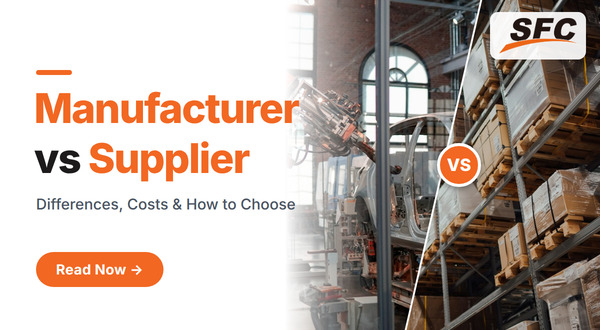
The labels alone will not tell you. One company may own the assembly line. Another may buy the lamps from that very factory and sell them to you. Either one can be your supplier. The useful questions are more down to earth: Who makes the lamp? Who sends the invoice? Who can change the wiring? And who sorts it out when 40 lamps arrive with cracked shades?
That is the heart of the manufacturer vs supplier decision. It is less about finding a magic label and more about knowing what each company can control for your order.
Manufacturer vs Supplier: Can a Business Be Both?
Yes. A manufacturer produces or oversees the production of goods. A supplier provides goods to a buyer. If you buy straight from a factory, that factory is both the manufacturer and your supplier.
“Supplier” is a broad business word. It can describe the plant making your product, a trading company selling goods from several plants, or a wholesaler with finished stock. It can also refer to someone supplying raw materials or components to the factory. Context matters. If you are talking about the finished product, ask who physically makes it and who sells it to you.
Even “manufacturer” can need a closer look. A bag factory might cut and sew bags in-house but buy zippers, fabric, and printed inserts elsewhere. That does not make it fake. Most products have a supply chain. What matters is whether the company controls the steps it promises to control and tells you when it outsources one.
Here is a practical map of the names you will meet:
| Party | What it usually does | First question to ask |
| Manufacturer / factory | Makes or manages production of the product. | Which processes happen at your site, and which are subcontracted? |
| Trading company | Buys from one or more factories and resells or coordinates orders. | Which plant makes this exact SKU, and may I review its evidence? |
| Wholesaler | Buys and resells stock, often in smaller quantities or mixed ranges. | Is this item in stock, and can you replenish the same version? |
| Distributor | Supplies products for a brand or defined market/channel. | Are you authorized to sell this brand in my channel and territory? |
| Sourcing agent | Finds or coordinates other suppliers, usually for a fee or commission. | Who pays you, and who will sign the purchase contract? |
| Third-party logistics provider (3PL) | Receives, stores, packs, and ships inventory under agreed instructions. | What happens when the inbound goods or labels do not match the plan? |
A company can wear two hats. It may manufacture its best-selling product and trade other products bought from a neighbor. So ask about the specific item on your purchase order, not just the company profile. For a fuller view of finding and comparing these routes, see this product sourcing process.
OEM, ODM, and private label are separate questions
These terms describe the product-development arrangement, not automatically the seller's identity. In an OEM arrangement, a factory makes a product to the buyer's specified design. In an ODM arrangement, a manufacturer typically offers an existing design that the buyer may adapt. “Private label” usually means selling a product under your own brand; the amount of design change can be tiny or substantial.
A trader can arrange any of these with a factory. Ask who owns the tooling, design files, approved sample, and changes to the bill of materials. A logo printed on a box is not the same thing as control over the product.

Follow the Product, the Invoice, and the Problem
Think of a purchase as three trails running side by side.
The product trail shows where materials come from, where the product is assembled, where it is packed, and where it goes next. The money trail shows who quotes, invoices, receives your payment, and pays the plant. The problem trail shows who investigates a defect and pays for a replacement, rework, or credit.
Those trails do not always lead to the same company. You might buy through a trading company, inspect at its partner factory, then send approved cartons to a separate warehouse. That's fine when the handoffs are written down. It gets messy when everyone assumes somebody else owns the problem.
Before placing an order, put these names on one page:
- The legal entity on the quotation and invoice.
- The site making the product and any significant subcontractors.
- The person who approves samples and production changes.
- The party arranging and paying for inspections and defect remedies.
- The party delivering cartons to the next warehouse or carrier.
Delivery terms matter here. An agreed Incoterm helps allocate delivery tasks, costs, and transport risk; it does not replace a clear agreement about product specifications, defects, or ownership. Spell out the named place as well as the term. “We will handle shipping” is a bit too fuzzy when a pallet goes missing.

When Going Direct to a Manufacturer Makes Sense
Direct factory contact is especially useful when the product needs work: a new mold, a particular fabric blend, a change to circuitry, or a packaging fit that must be tested. You can speak closer to the production team, revise the sample, and see what each change does to cost and schedule.
It also makes sense when you have repeat orders large enough to support a dedicated production run. Once a factory knows your approved sample and tolerance limits, the next run can be easier to manage. Well, assuming the instructions are still current. That last bit gets forgotten surprisingly often.
Say you sell travel pouches. Your first sample uses a recycled polyester shell, a specific zipper, and a printed card. A factory that cuts and sews the pouch can discuss stitching, fabric weight, seam placement, and what happens if that zipper is unavailable. You still need to identify the fabric mill and zipper source if those inputs are important to your claims or performance. “Made by the factory” does not mean every component comes from one building.
The catches: MOQ, setup work, and your own time
Factories often schedule production around minimum runs. An MOQ may apply to each color, size, material, or artwork version, not merely the order total. A quote for “500 pieces” means little until you know whether you can split them into five colors.
Then there are samples, molds, artwork plates, testing, and deposits. You may have to manage all of them yourself. If you need 60 pieces to test demand next month, the direct quote could be cheaper per unit yet more expensive as a whole first experiment.
Ask about sample revisions, tooling ownership, production lead time after sample approval, and the plan if a component is substituted. If you cannot answer those, you are not quite comparing finished offers yet.

When Another Supplier Is the Better Fit
A trading company can be handy when your order has products from several factories. Picture a kitchenware brand that needs a silicone spatula, a ceramic jar, and a printed carton. A single plant may make only one of them. A trader may gather the parts, coordinate samples, and handle export paperwork. That service has a price. It can also save you a lot of back-and-forth.
A wholesaler is useful when you want ready-made stock, a smaller trial buy, or a wide assortment. The trade-off is usually less say over the design and less certainty that the next batch will match. Check model numbers, batch information, and replenishment terms before you build a listing around a product.
A distributor is different again. For branded goods, check its relationship with the brand, the markets it may serve, and any channel restrictions. A good price does not help much if the paperwork will not support sales through your chosen marketplace.
A sourcing agent can help find factories, translate technical requirements, and coordinate visits or inspections. The agent's fee, incentives, and legal role should be plain. Is the agent acting for you, reselling the product, or receiving money from both sides? Ask. There is no prize for guessing.
None of these routes is automatically safer or cheaper. Pick the route that solves your actual constraint: product control, access to stock, a low-risk test, or help managing several moving parts.
The Factory Price Is Only Half the Quote
“Factory direct is cheaper” sounds sensible. Sometimes it is. But a $4.50 factory unit can cost more to launch than a $5.20 trader unit if the factory needs new tooling, a larger minimum run, and separate coordination.
Compare the same specification, quantity, inspection plan, delivery point, and packaging. Otherwise you are comparing a finished sandwich with a bag of ingredients. Both have bread in them, sure, but they are not the same purchase.
| Cost or condition | Direct factory quote | Intermediary quote | What to normalize |
| Product price | May be lower per unit. | May include service and margin. | Same materials, tolerances, and included work. |
| MOQ | May require a full production run. | May allow a smaller or mixed order. | Quantity per SKU, color, and pack. |
| Setup and samples | Often itemized. | May be bundled or still charged separately. | Tooling, revisions, and ownership. |
| Quality work | You may arrange inspection. | Intermediary may coordinate it. | Inspection scope and defect remedy. |
| Shipping to next location | Depends on delivery terms. | May be consolidated. | Exact named handoff point and charges. |
| Reorder risk | Direct access to capacity, but perhaps less stock. | Access to several plants, but another communication layer. | Lead time and ability to repeat the approved version. |
Here is an illustrative calculation, not an industry average. For 500 units, Factory A quotes $4.50 each, a $600 setup fee, $150 for inspection, and $200 for delivery to the receiving warehouse. That is $3,200, or $6.40 per unit, before any costs common to both options. Trader B quotes $5.20 each, no setup fee, $150 for the same inspection, and $200 to the same warehouse. That is $2,950, or $5.90 per unit. For this small run, B costs less overall. At a larger repeat volume, the one-time setup fee might change the result. Get the actual quotes and do the arithmetic again.
Also budget for defects, storage, outbound shipping, and returns. Those are not magically included because a sales page says “one-stop.” If you are comparing downstream providers too, a guide to comparing fulfillment quotes helps you ask for matching inputs.
How to Verify Who Really Makes Your Product
Start with a calm, specific question: “Which legal company will make this SKU, at which site, and which steps will it subcontract?” Then compare the answer with the invoice, contract, business registration, and sample records. An export company can be separate from the factory. That arrangement is workable; it simply needs to be visible.
Ask for a live discussion of the actual process: the machine or line used, the material input, the likely bottleneck, and the quality check for your design. A plant visit or independent audit may be worth the cost for a high-value or regulated product. A glossy showroom video is evidence that a showroom exists. It is not evidence that your batch will be made there.
For a first order, request:
- A dated specification and bill of materials, including critical materials, dimensions, tolerances, artwork, and packaging.
- An approved physical or documented “golden sample” with a revision number.
- A clear production schedule and the process for approving substitutions.
- An inspection plan: what gets checked, when, by whom, and what counts as a defect.
- A written remedy for failed inspection, shortages, or missed deadlines.
- Matching legal names and payment instructions; independently verify any last-minute bank-detail change.
An inspection cannot repair a bad specification. If you said “blue fabric” and the factory shipped the wrong shade of blue, you may have a hard argument unless the approved swatch and tolerance were recorded. For more on where quality checks can fit around China sourcing and warehousing, see quality checks in China.
Standards help, but they are not magic stickers
ISO 9001 concerns an organization's quality management system. A certificate may tell you something about processes and scope; it does not certify that your lamp or travel pouch meets every product rule. Check the certificate's legal entity, site, scope, and validity rather than just the logo on a slide.
For lot inspection, an agreed sampling plan can use ISO 2859-1 and an acceptance quality limit, or AQL. Set the defect categories and inspection level before goods are packed. Sampling reduces uncertainty; it cannot promise that every unit is perfect. Product-specific safety and labeling requirements depend on what you sell and where you sell it. Ask for relevant test reports tied to the actual model and materials, and check the destination rules rather than copying a competitor's badge.
The Product Category Changes the Right Questions
The same sourcing model does not work for every product. Materials and use conditions change what you need to verify.
| Product or industry | What can go wrong | Evidence to request | Route that may fit |
| Apparel and textiles | Wrong fiber, fading, inconsistent fit. | Fabric specification, approved color, size tolerances, wash or performance tests as relevant. | Direct cut-and-sew partner for custom designs; wholesaler for a small stock test. |
| Consumer electronics | Component substitutions, electrical failure, battery shipping limits. | Component list, model-specific testing, battery details, destination-market documentation. | Specialist manufacturer with traceable components and controlled changes. |
| Beauty and cosmetics | Formula variation, batch mix-ups, label mistakes. | Formula/version record, batch traceability, shelf-life evidence and market-specific label review. | Qualified contract manufacturer or specialist with clear batch controls. |
| Homeware and fragile goods | Breakage, finish defects, poor protective packaging. | Material and finish sample, carton specification, transit test or pilot shipment. | Manufacturer plus a clear packaging and receiving plan. |
| Food-contact packaging | Material or coating unsuitable for intended use. | Material declaration, relevant test evidence for the destination and intended contact conditions. | Specialist producer able to document the exact material system. |
These are prompts, not a universal compliance checklist. A battery product sold in the EU does not have the same requirements as a cotton tote sold in the US. When the rule is important, identify the product classification, destination, and current requirement before a deposit goes out.
For breakable stock, the factory's beautiful retail box may still need a transport pack. A useful fragile-product handling guide can help frame that discussion before your first shipment.
From a China Supplier to a Customer: Make the Handoff Boring
Now let us say your travel pouch comes from one factory, while another printer makes the insert card. You want both at the same warehouse before customer orders go out. The job does not end when each seller says, “Shipped!”
Give each producer the same receiving instructions: destination address, appointment or notice requirements, SKU and batch identifiers, carton count, carton dimensions and weight, and a packing list. Tell the receiving team what to do if the insert quantity is short or a carton label does not match the purchase order. No improvising with 300 nearly identical black pouches.
Use a versioned packaging specification sheet for the retail pack and outbound parcel. Include photos, material names, component codes, insert position, barcode location, and an approved sample. If you change the card copy, send a new version and retire the old one. A screenshot buried in chat is a rough place to run a packing line from.
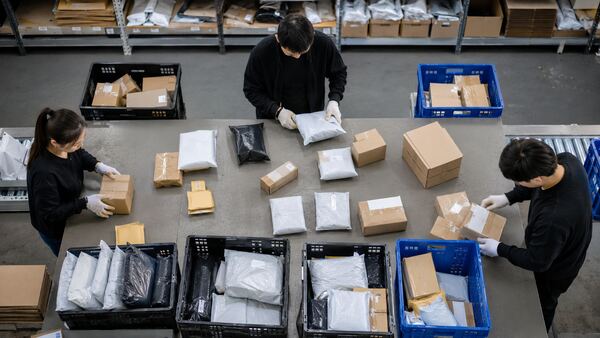
When items arrive from several producers, package consolidation may simplify the onward shipment or assemble one sellable kit. But decide who checks each inbound carton, who records shortages, and who authorizes kitting. Consolidating unchecked mistakes just puts them in one box.
A China fulfillment center can be a useful concept to evaluate for storage, order picking, packing, and dispatch after production. The actual service scope must be confirmed with the provider. Manufacturing quality, product compliance, warehouse receipt, and parcel delivery are related jobs with different owners. Write down the point where one owner's work ends and the next owner's begins.
A Decision Checklist Before You Pay a Deposit
You do not need a 60-page sourcing policy for your first order. You do need clear answers to these:
- Who is who? Name the manufacturer, seller, payee, and delivery party for this SKU.
- What exactly are you buying? Keep a dated spec, approved sample, materials, labels, and packaging instructions.
- Are the quotes comparable? Normalize quantity, setup, quality checks, delivery terms, and destination.
- What is the real MOQ? Check it by color, size, variant, and packaging option.
- What happens when something fails? Agree on inspection timing and the remedy before production.
- Can you legally sell and ship it? Confirm evidence for your product and destination.
- Who handles the handoff? Send carton data and receiving instructions to the next partner.
- Can you start small? Run a pilot where practical, then revise the spec using what you learned.
One honest question wraps it up: Can this business deliver my exact product, at my volume, into my sales channel, and show me what happens if it goes sideways?
Conclusion
A manufacturer makes a product. A supplier supplies it to you. Sometimes they are the same company; sometimes several businesses sit between the production line and your store.
The right choice depends on what you need to control. Go direct when product detail and repeat production justify the work. Use a trader, wholesaler, distributor, or agent when its service solves a real problem for your order. Either way, follow the product, the invoice, and the problem. Those three trails tell you much more than a badge saying “factory.”
Frequently Asked Questions
Is a manufacturer also a supplier?
Yes, if the manufacturer sells or provides its goods to you. “Manufacturer” describes the production role; “supplier” describes the supply relationship. A factory can fill both roles on the same purchase.
Can a supplier sell products it does not make?
Certainly. Trading companies, wholesalers, and distributors often do. The important point is disclosure. Ask which factory makes the exact item, who controls changes, and who handles defects.
Is buying directly from a manufacturer always cheaper?
No. Direct unit pricing can be lower, but tooling, MOQ, samples, inspection, and coordination can make a small first run cost more overall. Compare the same product and delivery point, then calculate total cost.
How can I tell if an Alibaba seller is a factory or a trading company?
Ask which site makes the SKU and which legal entity invoices you. Compare registration details, product-specific process knowledge, sample records, and, when warranted, an independent audit. A marketplace label or video alone is not enough.
What is the difference between a supplier and a distributor?
Supplier is the broader term. A distributor is a type of supplier that handles a brand or product line in a market or channel. If branded resale matters, verify its authorization and any territory or marketplace limits.
When should I use a wholesaler instead of a manufacturer?
Try a wholesaler when you need ready stock, a mixed selection, or a small demand test. Use a manufacturer when you need meaningful customization and can support the production run and setup work.
Can a trading company arrange private-label products?
Yes. It may coordinate a factory, artwork, packaging, and export work. Clarify who owns the design and tooling, which factory makes the goods, and how changes and defects will be handled.
What documents should I request before paying a China supplier?
Start with the legal company details, a written quote and contract, product specification, approved sample record, production schedule, inspection terms, and payment instructions. Add category-specific test or compliance evidence for your destination.
Who is responsible if the product fails inspection?
Your purchase contract should answer that before production. It may require the seller to repair, replace, remake, or credit goods that fail agreed criteria. Who pays for a second inspection or delay should also be written down.
Can I buy from several manufacturers and use one fulfillment partner?
Often, yes, if the partners can deliver to the same receiving point and the warehouse agrees to the workflow. Share SKU and carton data, inspect inbound goods, define assembly or kitting instructions, and confirm the fulfillment scope and fees in advance.
 Post Views:13
 TAGS:
TAGS:
Copyright statement: The copyright of this article belongs to the original author. Please indicate the source for reprinting.
Previous Post
Next Post
TAGS
Hot Research
Get Custom eCommerce Fulfillment Service
Book a Meeting
Get a Custom China Fulfillment Solution with FREE Storage for 30 Days
Want to know about our services, fees or receive a custom quote?
 Want to know about our services, fees or receive a custom quote?
Please fill out the form on the right and we will get back to you within a business day.
The more information you provide, the better our initial response will be.