Your mug supplier is in Jingdezhen. Your printed boxes come from another supplier near Shenzhen. A customer in Toronto orders the mug on Monday. Who checks that the right mug goes into the right box, adds padding, prints the shipping label, and sends back tracking?
That is the job a China fulfillment center can take on. It sits between your suppliers and your customers. Instead of asking each factory to handle individual overseas orders, you send stock to one operation that receives, stores, packs, and dispatches it under your rules.
Sounds simple. It can be, once the handoffs are clear. The awkward bits tend to show up in the spaces between teams: a carton arrives without a SKU label, a store sends a canceled order, or the parcel's customs description says “gift.” This guide walks through the actual work, the costs, and the questions to settle before you ship your first batch.
What a China Fulfillment Center Actually Does
A China fulfillment center is a
warehouse operation based in China that prepares and ships orders for sellers. Finished goods arrive from one or more suppliers. The center receives them, records inventory, stores each
SKU, picks items when orders arrive, packs them, and hands parcels to a
shipping carrier. The center may also inspect stock, assemble kits, add branded materials, or prepare bulk shipments, depending on the agreement.
People often call the company operating the center a
3PL, short for third-party logistics provider. The facility is the physical place; the 3PL is the business running the service. In everyday conversation, people mix the two terms. No great harm there, as long as you know what the provider actually does.
A regular warehouse might simply hold cartons. A fulfillment center handles outgoing orders, too. A freight forwarder mainly arranges the movement of cargo between places. A factory may ship each order itself, but that leaves fulfillment tied to its own products and processes. These services can work together. They are not always interchangeable.
| Model |
Where stock sits before an order |
Main job |
Usually useful when |
| China fulfillment center |
At a managed warehouse in China |
Store, pick, pack, and dispatch individual orders |
Suppliers are in China and customers are spread across markets |
| Factory-direct shipping |
Usually with the supplying factory |
Ship that factory's products after an order arrives |
You are testing a small range and can accept the factory's packing process |
| Destination-country 3PL |
In a warehouse near your customers |
Deliver from local stock |
Demand is concentrated and a fast local delivery promise matters |
| Freight forwarder |
Stock moves between suppliers, ports, and warehouses |
Arrange transport for consolidated cargo |
You need to move inventory in bulk between locations |
One important distinction: using a center does not automatically mean the center buys your inventory. Many brands own the stock and pay the center to handle it. Confirm who owns each unit, when ownership changes, and what happens to unsold stock. These details become rather important if you change providers.
Follow One Order From Factory Floor to Customer Door
The easiest way to understand the setup is to follow the mug. There are two big handoffs: supplier to warehouse, then warehouse to carrier. Your store and customer sit on either side of those handoffs.
The supplier-to-warehouse handoff
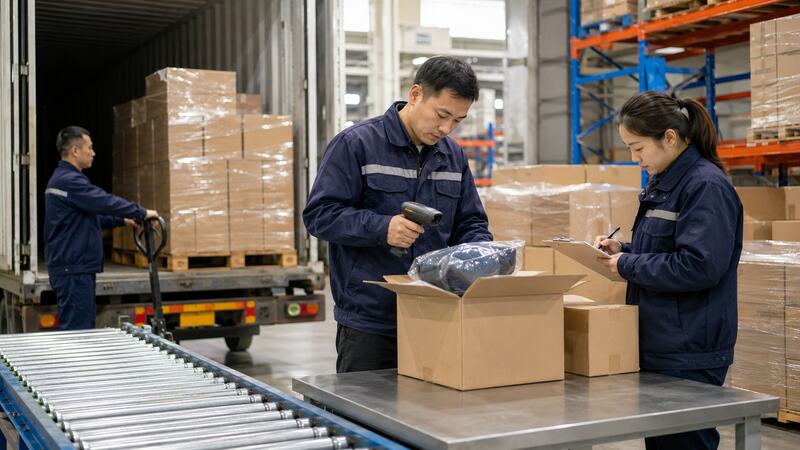
Before the supplier sends anything, the brand provides the warehouse with an advance shipping notice, usually called an ASN. This says what is coming, how many cartons to expect, which SKUs are inside, and who sent them. The supplier needs carton labels that match the notice. Otherwise, receiving can turn into a guessing game.
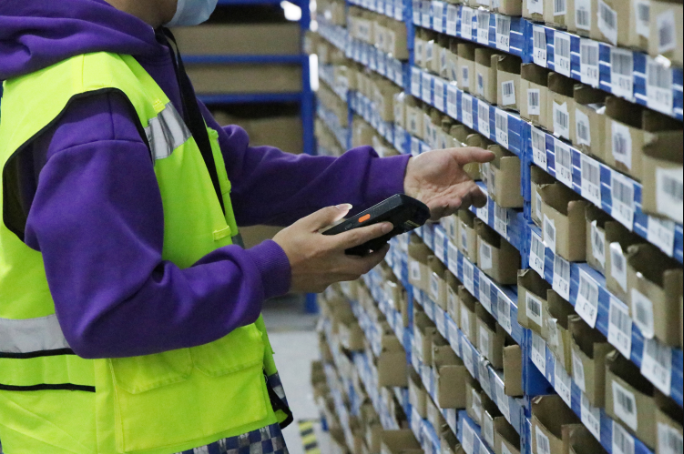
On arrival, staff count cartons and units, inspect the agreed sample or condition points, and record discrepancies. They then put accepted units into storage and make them available in the warehouse management system, or
WMS. Damaged or unidentified items need a separate status. You do not want a chipped mug sitting in “available” stock because nobody had a place to put it.
Define what a receiving check includes. Is it carton count only? A unit count? Photos of visible damage? A sample inspection for glaze defects? A warehouse receiving check is not the same thing as a full factory quality inspection. Say which one you need, who pays, and what evidence you expect back.
If several factories feed one inventory pool, China warehousing can give those incoming goods a shared receiving point. You still need to tell each supplier how to label and deliver its cartons.
The warehouse-to-carrier handoff
Now the Toronto customer pays for the mug. Your store sends the order to the 3PL through an app, an API, a file, or a manual portal. The warehouse checks that the address and chosen service are usable, locates the correct SKU, scans or verifies it, and packs it according to your instructions.
For this mug, those instructions might specify a corrugated outer carton, cushioning that stops movement, and a branded card. A T-shirt would need a different setup. The point is that “pack my orders nicely” is not a pack rule. A photo of an approved sample pack is much more useful.
The warehouse creates the label and shipping documents, then hands the parcel to a carrier or shipping network. The package may travel through export handling, an international leg, destination customs, and a local delivery partner. A generated tracking number tells you a shipment was created. It does not prove that the last-mile carrier delivered it.
Tracking should flow back into your store, where your customer can see meaningful updates. Decide who handles the “where is my order?” message if scans stop. The fulfillment center can supply parcel events and investigation details; your brand still owns the customer promise.
It often fits a brand whose suppliers, packaging, and assembly work are mostly in China but whose customers live in several countries. Instead of forecasting separate inventory for the US, Canada, the UK, and Australia, the brand can keep a controlled pool near its suppliers and send individual orders to the relevant markets.
That can be helpful for a new DTC product, a crowdfunding campaign with scattered backers,
subscription-box components from multiple factories, or slow-moving variants. Picture a phone case sold in 12 colors. Shipping a deep stock of every color to four countries may tie up more cash than the demand justifies. Holding the long-tail colors in China could make more sense.
But parcel weight, delivery expectation, and returns can flip the decision. A heavy desk lamp sold almost entirely to US customers may work better in a US warehouse. So may a product advertised with two-day delivery. A skincare line with frequent local returns or tight destination-market rules deserves a separate check before choosing any cross-border route.
A hybrid model is often the least dramatic answer: put your bestselling SKUs near a big customer base and keep uncertain or low-volume variants in China. Test the split with real order data. Do not assume the cheapest pick fee gives the cheapest total outcome.
Ask yourself four things before choosing a model:
- Where are the goods made, and how many suppliers feed each order?
- Where do buyers live, and what delivery window have you promised them?
- What are the product's packed weight, dimensions, return rate, and handling needs?
- How much cash and forecasting risk come with stocking a destination warehouse?
If you cannot answer those yet, start with a limited pilot. There is no prize for sending all your inventory to a new location on day one.
How to Use a China Fulfillment Center Without a Messy Launch
The center can do physical work only after you give it the right information. Here is a practical setup sequence. It is built around what changes hands, not around a glossy list of services.
Step 1: Decide what the center will fulfill
List your sales channels and mark which orders should come from China. Perhaps your Shopify orders to Canada, Australia, and the UK go to the China center, while US orders for two bestsellers go to a local 3PL. Put that rule in writing.
Next, name an owner for each decision. The brand owns its product information, customer offer, approved packaging, and customer service policy. The supplier owns making and correctly labeling the goods it sends. The warehouse owns the receiving, storage, picking, and packing work defined in its agreement. The transport provider moves the parcel. Customs responsibilities depend on the route and commercial terms and must be agreed rather than guessed.
Write down the delivery promise you plan to show at checkout by destination and service. If a carrier quotes a transit range, find out when the clock starts. Is it the time you release the order, the warehouse dispatch date, or the carrier acceptance scan? Those are different moments.
Step 2: Build a product record a picker can trust
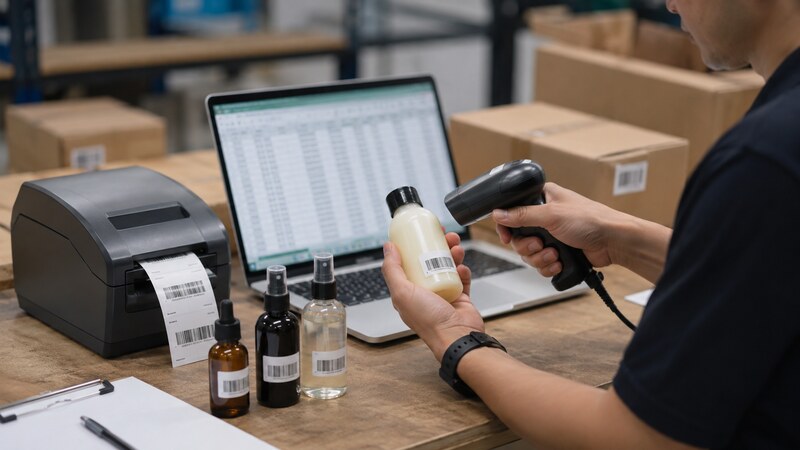
Each sellable variant needs a distinct SKU. A blue mug and a green mug should not share one record because they have the same shape. Give the warehouse a product name, variant, unit dimensions and weight, expected barcode or scan identifier, supplier, and photo. Add carton quantities and dimensions for inbound receiving.
Then include the fields people tend to remember too late: fragile handling; battery or liquid contents; expiration or lot control where applicable; bundle components; country of origin; accurate product description; and who approves substitutions. These details affect storage, packing, shipping eligibility, and customs data.
A merchant SKU is your own stock-keeping identifier. A GTIN identifies a trade item under GS1 rules and may appear in a UPC or EAN barcode. They are not the same thing. Retail and marketplace requirements vary.
GS1's explanation of barcode types helps you match the identifier to where an item or carton will be scanned. Confirm the precise barcode format with the sales channel and warehouse.
If your item file is more complicated than a few mugs and colors, use a
product master data checklist before any cartons arrive. One corrected spreadsheet now can save a week of “which blue is this?” later.
Step 3: Agree on receiving, checks, and stock status
Send every supplier a small inbound instruction sheet. It should say where to deliver, how to label outer cartons, what to put in the ASN, whether mixed SKUs are allowed in one carton, and whom to call when quantities change.
Ask the warehouse to show you its receiving record. You want a traceable path from supplier shipment to warehouse receipt, from receipt to the individual SKU balance, and from balance to sellable or held status. If 480 units were shipped but 468 were received, who investigates, and by when? The answer should be agreed before the shortage happens.
For products with dates or batches, add the rotation rule. Food, beauty products, and some regulated goods may need lot or expiry visibility. Electronics might need serial-number capture for warranty work. A basic apparel SKU may need neither. Apply controls because the product needs them, not because every WMS feature looks nice in a demo.
Have a process for rejects. The warehouse may quarantine a wet carton, photograph it, and ask whether to relabel, return, repair, or dispose of its contents. Without an owner and decision window, rejected stock can sit on a shelf indefinitely, still costing you money.
Step 4: Make packaging a repeatable instruction
Packaging has two jobs: protect the item and fit the delivery channel. It may also represent your brand. The trick is to write a pack specification that a different team member can follow tomorrow.
For each product or kit, state the inner protection, outer mailer or carton, maximum movement inside the box, seal, insert, and any
shipping-label placement rule. Choose materials for the risk. A ceramic mug may need a tested corrugated box and cushioning. A soft T-shirt may fit a paper or plastic mailer if the route and moisture exposure allow it. A glass bottle may need a closure check and leak protection. An oversized carton full of air adds chargeable volume and lets products rattle around.
Ask for a packed sample and photos from several angles. Check that the barcode scans, the product stays put, the insert faces the right way, and the outer package survives the handling you expect. If the parcel is fragile, test the actual packed configuration before scaling. A “fragile” sticker is not a substitute for protection.
Branded cards need their own simple rules. Which orders receive one? In what language? What happens when the cards run out? If the warehouse silently swaps in an older version, a small marketing detail can become a customer-service issue. Yep, paper can cause trouble too.
Step 5: Connect orders, inventory, and tracking
A small pilot might begin with a carefully controlled CSV or portal upload. At higher volume, an app or API usually reduces manual copying. Whatever the method, prove that it transfers the right order, SKU, quantity, address, shipping instruction, and status. Those six things matter more than the connector's marketing page.
Test the direction of each data flow. Does the storefront send paid orders only? How often does stock update? If you cancel an order, does the warehouse see it before picking? If a 3PL rejects a request, is the customer order held or rerouted? After dispatch, does tracking return to the correct order and buyer notification?
For Shopify stores,
Shopify's fulfillment service guidance explains how an app-based provider can accept requests, update
fulfillment status, and send tracking. Actual behavior depends on the provider's app and your store configuration. Check fulfillment locations and routing when some stock also sits outside China.
WooCommerce sellers should confirm what their chosen connector does with order changes, refunds, and stock reservations. Marketplace sellers need to check each platform's rules, not assume the same feed works everywhere.
Amazon FBM means shipping a customer order;
Amazon FBA means preparing inventory to go into Amazon's network. A center might support both, but they are different workflows with different labels and instructions.
This is where a provider's
ecommerce fulfillment service needs to match your actual stores, order volume, and shipping destinations. Ask for a live mapping example using one of your SKUs, not just a list of platform logos.
Step 6: Agree on shipping, customs, and who answers the customer
Create shipping rules by destination, parcel size, product restrictions, and customer promise. A cheap route with sparse tracking might suit a low-value accessory. A high-value replacement part may need stronger tracking or signature handling. Ask what happens if the first selected route cannot take a battery or is suspended for a destination.
The declaration must describe the item honestly. “Accessories” is a poor substitute for a specific product description. Make sure origin, value, quantity, and classification have an accountable owner. Also agree who prepares documents, who acts as exporter or importer where relevant, who pays duties and taxes, and what the buyer sees at checkout. These arrangements can differ by destination and shipping product.
Customer support needs its own handoff. Your team should see when a parcel is picked, handed to a carrier, delayed, delivered, or returned. The warehouse should have a clear path for an address correction, damaged-item claim, or customs hold. A useful rule is simple: the party that spots the problem first raises it, but one named person owns the customer response.
Step 7: Run test orders and keep a daily exception list
Do a pilot with real products and realistic destinations. One perfect order proves very little. Use a normal single-item order, a mixed cart, a last-minute cancellation, a bad address, a stock shortage, and at least one destination with more complex paperwork. If returns matter to your category, rehearse that path as well.
Record what actually happened: order received time, warehouse release time, carrier acceptance, tracking update,
final delivery, package condition, and total charge. Photograph the test parcel at the customer's end if you can. A parcel that looks good on the packing bench can look rather less good after an international trip.
During launch, keep a shared exception list. Note the order number, issue, owner, next action, and deadline. Useful measures include inventory variance, wrong-item rate, time from paid order to warehouse dispatch, parcels with no carrier acceptance scan, and customer contacts about shipping. Agree how each metric is calculated. “Shipped on time” has little meaning if one side counts label creation and the other counts physical handover.
If you want a calendar for this work, SFC's
first-month onboarding plan goes into the sequence in more detail. For this guide, the main rule is: pass each test before adding more SKUs or destinations.
Know the Full Cost, Not Just the Pick Fee
The pick-and-pack number is only one line. A fair comparison includes the money spent before the order ships and the cost of problems after it ships.
For a planning model, use:
Per-order economic cost = allocated supplier-to-warehouse freight + receiving + storage + pick and pack + packaging + international postage + applicable duties and taxes + expected return and exception cost.
How you allocate shared costs matters. If a supplier sends 500 units in one carton shipment, spread the inbound charge across the units that actually become sellable. If some products occupy more space or move slowly, do not pretend storage costs the same for every SKU.
| Cost layer |
When it appears |
What to ask the provider |
| Supplier-to-warehouse transport |
Before stock is received |
Who books pickup and who pays for failed delivery? |
| Receiving and inspection |
When cartons arrive |
Is pricing per carton, unit, hour, or inspection level? |
| Storage and inventory handling |
While units wait or are moved |
What is the billing unit, free period, and aging rule? |
| Picking, packing, and materials |
With each order |
Are extra items, inserts, custom cartons, and relabeling separate? |
| International shipping |
After dispatch |
How are weight, dimensions, destination, fuel, and remote areas charged? |
| Duties, taxes, and customs services |
By route and destination |
Who pays, who collects from the buyer, and what is included? |
| Returns, losses, and exceptions |
When things go wrong |
What are the investigation, return-processing, and compensation terms? |
Here is an illustrative calculation, not a market price quote. Suppose allocated inbound and receiving cost $0.35 per order; storage costs $0.20; pick and pack $0.85; packaging $0.40; shipping $6.00; and an allowance for returns and exceptions $0.50. That gives $8.30 before any applicable duties or taxes. A quote showing only the $0.85 pick fee tells you very little about the real $8.30 planning figure.
Now compare the same product shipped from a destination warehouse. Add bulk freight, import costs, local storage, local fulfillment, and local postage. Consider cash tied up in unsold stock and any delivery benefit that improves conversion or reduces support tickets. The answer depends on your products and buyers; it is not a one-line “China always saves 40%” story.
SFC's
China fulfillment pricing guide breaks down quote components in more depth. When you request rates, send the provider your packed dimensions, weights, destinations, monthly order mix, and packing rules. Without those inputs, the quote is a placeholder.
Cross-Border Rules and Materials That Can Change the Plan
International fulfillment adds a few rules that domestic warehouse demos tend to skip. The first is product eligibility. A parcel route that accepts a cotton T-shirt may refuse a lithium battery, aerosol, certain cosmetics, or a liquid. Carrier limits, packaging instructions, destination rules, and product certifications can all matter. Check the exact SKU and lane before taking orders.
The second is customs data. The
World Customs Organization's Harmonized System supplies the shared framework for classifying traded goods. The correct code, declared value, country of origin, and product description must reflect the real item. The destination country may use a more detailed tariff code and impose its own duties, taxes, or documentation requirements. A warehouse can help move data and prepare shipments, but the brand should know who is legally responsible for each declaration.
The third is the delivery arrangement. Under a duty-paid option, charges may be built into the merchant's shipping arrangement; under a duty-unpaid option, a buyer may face payment before delivery. People often call these
DDP and DAP arrangements, but the commercial terms, carrier service, checkout promise, and importer role all need to line up. Ask the provider to explain the specific route in plain English:
Who pays what, at what point, and what happens if the buyer refuses the parcel?
Materials matter too. Corrugated cartons have different strength and sizes; mailers, bubble wrap, molded paper, and air cushions have different protective qualities. Some destination markets or marketplaces have packaging, labeling, or producer-responsibility rules. A sustainability claim about a mailer does not cancel out a damaged product and replacement shipment. Test protection first, then trim wasted space and material.
Finally, agree how restricted stock is flagged in the WMS. A battery variant should not slip into an ordinary parcel route just because its store listing looks like the non-battery version. Good data, shelf labels, packing rules, and carrier selection all need to tell the same story.
What About Returns and Problems After Delivery?
Returns are where a nice-looking fulfillment plan sometimes falls apart. A buyer in Paris may not want to mail a $20 item all the way back to China. For some categories, a local return address and periodic consolidation work better. For others, the brand may authorize a refund without requiring a physical return. High-value goods might justify inspection and resale, repair, or shipping back to a China facility.
Set a written return authorization process. Who approves the return? Where does the customer send it? Who checks condition? When does inventory become sellable again? What happens to a personalized item, a hygiene-sensitive product, or an opened cosmetic? These decisions involve your return policy, local rules, and the economics of the product.
Also plan for failed delivery. If a parcel is held for unpaid charges or an incorrect address, the buyer, carrier, warehouse, and your support team may all see different information. Agree when a case is escalated, which evidence is gathered, and whether you attempt redelivery, return, or disposal. A missing scan deserves an investigation, not an automatic claim that the parcel was lost.
Do a monthly reconciliation of returned and adjusted stock. One physical return should create one clear inventory event. If it creates two, or none, your stock number will drift. That is how overselling starts.
A Short Checklist for Choosing a China Fulfillment Partner
You do not need the “biggest” center. You need a provider that can show you how your exact orders will move. Ask for examples, documents, and a trial using your real product.
- Receiving: Can it show a sample ASN, carton-label instruction, discrepancy report, and quarantine workflow?
- System: Can it demonstrate your SKU mapping, stock sync, canceled orders, tracking return, and exportable inventory history?
- Packing: Will it make and photograph an approved pack sample? Can it handle kits, inserts, fragile goods, or lot control if required?
- Shipping: Can it quote your actual destinations, packed weights, prohibited-item checks, tracking detail, and expected dispatch cutoff?
- Commercials: Can it provide a complete rate card covering storage, receiving, extra items, materials, shipping, returns, and adjustments?
- Accountability: Who investigates a wrong pick, lost stock, damaged order, or parcel without a scan? What evidence and remedy apply?
- Exit: How do you retrieve inventory and data if you change providers?
The last question matters. A healthy 3PL relationship should make your stock more visible, not hold it hostage behind an unclear inventory file.
Conclusion
A China fulfillment center gives your brand a place to bring suppliers, inventory, packing rules, orders, and international dispatch together. The value comes from clear handoffs. Each carton needs an identity; each order needs the right route; each exception needs an owner.
Start with one manageable group of SKUs and a few destinations. Check packed costs and real delivery events, not only quoted fees or a printed label. If the process holds up, expand. If most customers demand fast local delivery, keep the right stock closer to them. The best setup is the one that fits your products, your customers, and the promises on your checkout page.
FAQs
Is a China fulfillment center the same as a China 3PL?
The center is the facility that receives, stores, and dispatches products. A 3PL is the outside business running those services. People often use the names interchangeably. What matters is the scope in your agreement: receiving, inventory control, order packing, shipping arrangements, tracking, and exception handling.
How is it different from dropshipping or a freight forwarder?
In a typical inventory-led fulfillment setup, your products are already at a center before a customer orders. In factory-direct dropshipping, the supplying factory may hold and send the products itself. A freight forwarder usually arranges movement of cargo, often in bulk. Some companies offer more than one of these services, so check the actual workflow.
Do I have to buy inventory before using a center?
Usually you need available stock at the facility if you expect it to pick and ship orders promptly. That stock may belong to you, a supplier, or another party, depending on the contract. Clarify ownership, payment terms, and whether units can be reserved before assuming there is no upfront inventory commitment.
Can I connect a China fulfillment center to Shopify or WooCommerce?
Often, yes, through an app, API, connector, CSV exchange, or controlled manual upload. Verify what the specific provider supports. Test SKU matching, location assignment, stock updates, cancellation timing, fulfillment status, and tracking before sending production orders through the connection.
Can the same center handle Amazon FBA and FBM?
Some can, but the tasks differ. FBM means the merchant's provider ships customer orders. FBA preparation means labeling and packaging stock for delivery into Amazon's fulfillment network under its current requirements. Ask whether the warehouse supports both separately and confirm the marketplace rules for your products and destination.
How long will orders take to reach customers?
There is no reliable single number. The destination, parcel type, selected shipping service, warehouse processing time, customs, and last-mile carrier all affect delivery. Ask for lane-specific historical results and agree when a promised window begins. Run test orders before showing a tight date at checkout.
What charges should I request in a quote?
Ask for inbound receiving, storage, picking, extra items, packaging, value-added work, international postage, weight and dimension adjustments, customs handling, returns, inventory disposal, and any minimums. Provide your actual product and destination data so providers price the same order mix.
Who handles customs duties and product compliance?
It depends on the shipping arrangement, destination rules, and the parties named in your documents. Your provider may help prepare shipments, but you should identify the exporter, importer, declaration owner, duty payer, and party responsible for product compliance. Do not assume “handled by the 3PL” answers every legal or customer-facing question.
Can a center combine goods from several Chinese suppliers?
Yes, if it offers receiving, storage, and the kit or order assembly you need. Give each supplier its own inbound labels and ASN, and define how the center checks quantity and condition. For a bundle, specify its components and what happens when one part arrives late.
How do international returns work?
Agree on a return address and disposition before launch. Depending on the product, you might use a local returns partner, send goods back to China, consolidate returns periodically, or refund without a physical return. Set rules for inspection, restocking, damage evidence, and customer communication so an incoming parcel does not vanish from your stock records.









 Post Views:9
 TAGS:
TAGS:
 Want to know about our services, fees or receive a custom quote?