




Table of Contents
Get Custom eCommerce Fulfillment Service
Book a Meeting
Fragile Product Fulfillment From China: Packaging and Handling Requirements
Time: Sep 20,2026 Author: SFC Source: www.sendfromchina.com
A ceramic mug can leave a Shenzhen factory looking perfect and reach a customer in California sounding like a small bag of ice. Between those points, it was loaded, stacked, sorted, and loaded again.
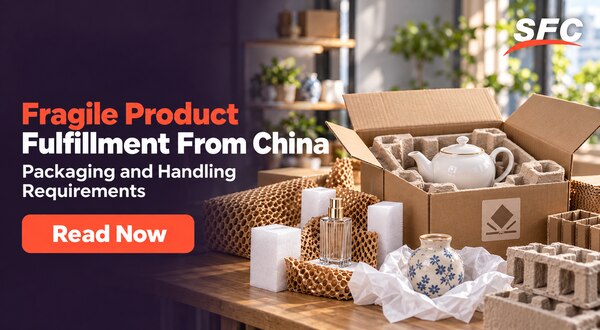
Fragile product fulfillment is therefore not just a box problem. It is a chain of decisions involving the supplier, China fulfillment center, parcel carrier, and last-mile partner. Brands need a clear packaging specification, a repeatable warehouse process, route-matched testing, and evidence when something still goes wrong—without turning every parcel into an expensive foam fortress.
Fragile Is a Failure Mode, Not Just a Glass Label
In ecommerce, “fragile” should describe what can fail, not what a product is made from. Glass and ceramics are obvious. Yet a metal camera is fragile if an impact shifts its lens. A skincare bottle may survive a drop but leak. A collectible might work while its crushed retail box makes it unsellable.
Useful failure categories include:
- Breaks, cracks, chips, or punctures
- Leakage or loose closures
- Scratches, scuffs, dents, and damaged finishes
- Bent corners or crushed retail packaging
- Deformation of soft or thin components
- Electrostatic damage to electronics
- Movement of lenses, sensors, or calibrated parts
- Item-to-item collision in multi-unit orders
Write the acceptance criteria before stock arrives. Does one mark make a gift box unacceptable? Must a pump remain locked? If nobody defines “good,” warehouse staff will make that call one parcel at a time. Results get wobbly, fast.
Damage can be cumulative. A parcel may survive one drop but fail after repeated vibration and smaller impacts. Risk runs from supplier pack-out and domestic inbound transport through receiving, storage, packing, cross-border sorting, and last-mile delivery.

Map Product Risk Before Choosing Packaging Materials
Start with the product’s weak point. Packaging should control a known failure, not simply look protective.
Record the weight, dimensions, center of gravity, fragile faces, protrusions, surface finish, moving parts, closures, accessories, battery details, and retail-pack condition. Then consider the order profile. One glass shipped alone behaves differently from four glasses beside a metal opener.
The table below is a starting point, not a universal recipe.
| Product or industry | Likely failure mode | Packaging priority | Handling requirement |
| Glassware and ceramics | Chips, cracks, broken handles, item collision | Individual separation, fitted cushioning, edge and wall clearance | Avoid loose stacking; control orientation when needed |
| Cosmetics and liquids | Leakage, broken pumps, loose caps, stained cartons | Closure check, sealed secondary containment, dividers, absorbent material where suitable | Keep upright if required and separate questionable units |
| Electronics and sensors | Shock, vibration, ESD, connector or screen damage | Fitted inserts, accessory separation, anti-static protection when required | Use clean handling and functional checks for defined risks |
| Art, collectibles, and gifts | Abrasion, bent corners, presentation-box damage | Non-abrasive wrap, corner protection, protected outer carton | Define cosmetic acceptance standards with photos |
| Lighting and irregular products | Stress around arms, shades, joints, or protrusions | Custom supports, immobilization, reinforced outer packaging | Do not lift by a fragile extension or unsupported feature |
| Board games and crowdfunding rewards | Crushed corners, split boxes, mixed-part errors | Corner guards, snug outer carton, component control | Use order-level pack rules for add-ons and reward tiers |
Some products sit in two risk groups. Perfume, aerosols, alcohol-based goods, and lithium-battery devices may be fragile and transport regulated. Protective packaging does not replace dangerous-goods classification, documentation, or carrier approval.
Build the Package in Layers, Not by Guesswork
A good pack works like a bicycle helmet. The outer shell, energy-absorbing layer, and secure fit do different jobs. More of one layer cannot always fix a missing one elsewhere.
Protect the surface and primary pack
The first layer keeps the product clean and stops rubbing. It may be tissue, a sleeve, a bag, a soft film, or non-abrasive wrap. Retail packaging needs special attention. A printed box may be part of the experience, but it rarely belongs alone on conveyors. Treat it as something to protect unless testing proves otherwise. SFC’s guide to branded and protective packaging in China explains how product packaging, internal protection, and the shipping carton serve different purposes.
Immobilize, cushion, and separate
These words sound similar, but they are not the same job.
- Void fill reduces empty space and helps limit movement.
- Blocking and bracing hold the product in its intended position.
- Cushioning manages shock before it reaches the product.
- Dividers prevent products or components from hitting each other.
Think of an empty box as a tiny room. If the product can move across it, it gets a running start before hitting the wall. A little paper on top does not remove the runway.
Material choice follows the load and failure mode. Molded pulp and corrugated structures hold products in position. Engineered foams provide fitted cushioning when their density suits the product. Bubble film protects lighter items and edges. Air columns fit some bottles and electronics. Honeycomb board and corner guards spread loads. Kraft paper handles many void-fill jobs, but loose paper is not magic shock protection.
Do not allow casual material swaps. A softer foam, thinner carton, or partly inflated air cushion can change performance. Put approved alternatives in the packaging bill of materials.
Choose the shipping carton and seal
The outer carton must suit the packed weight, shape, stacking exposure, and route. It also needs to be sound. A crushed crease is like a bent knee: it may stand, but it has lost some confidence.
Single-wall boxes may suit light products with fitted protection. Heavy, brittle, expensive, or irregular goods may need double-wall board or a box-in-box design. Double boxing helps only if the inner carton is immobilized.
Seal cartons with approved tape and a defined pattern. Remove old labels and irrelevant markings. A fragile label may alert a person, but it cannot stop a sorter or fix a weak pack.
Special cases: liquids and electronics
For liquids, test the closure first and add leak containment where appropriate. For electronics, consider ESD, connector movement, screen pressure, batteries, and loose accessories. Use static-control materials when required. “Looks cushioned” is not an ESD specification.

Warehouse Handling Requirements a China 3PL Should Document
Great packaging can still fail in a loose warehouse process. A fragile-SKU SOP should cover receiving, storage, picking, packing, inspection, and exceptions.
Receiving: inspect before responsibility becomes blurry
At receiving, record the supplier, purchase order, carton count, arrival time, and carton condition. Photograph crushed corners, water marks, punctures, broken seals, and unusual re-taping before unpacking.
Inspection should reflect the risk. It may include opening selected cartons, checking retail packs and closures, counting accessories, or performing a defined functional check. Uncertain units need physical and WMS quarantine—not a handwritten note beside good stock.
A process for managing damaged inventory at a China fulfillment center preserves evidence and keeps questionable goods out of orders. Photos, timestamps, quantities, batch details, and carton condition are far more useful than “some units were broken.”
Storage: use system flags as well as shelf labels
Fragile inventory may need restricted stacking, stable shelving, moisture control, or separation from heavy goods. Long items should not hang beyond a shelf.
WMS flags can trigger storage rules, pack instructions, checks, or carrier restrictions. Some cosmetics, electronics, regulated goods, and high-value items also need lot, batch, or serial tracking.
Picking and packing: make the correct method repeatable
Every fragile SKU needs an approved pack recipe. It should state:
- Product orientation and quantity per parcel
- Approved inner and outer packaging
- Insert, divider, cushioning, and corner-protection details
- Closure and sealing method
- Multi-item compatibility rules
- Required labels and documents
- Final inspection points
- Approved substitutions and who may authorize them
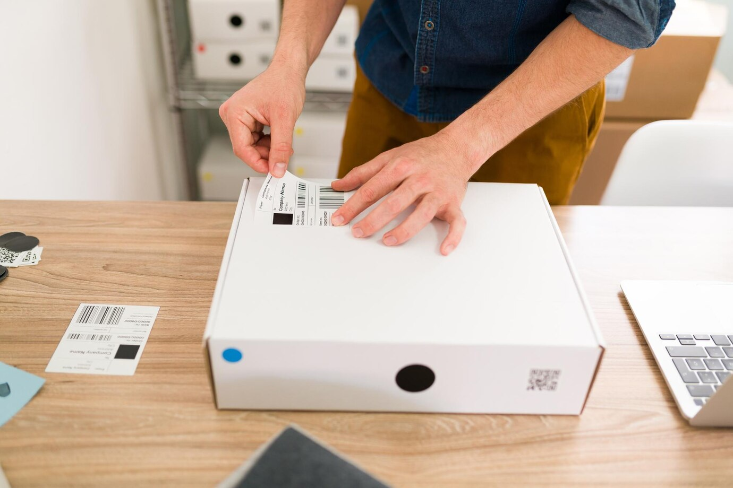
Use photos or short diagrams at the bench. “Wrap securely” leaves too much room for interpretation: one packer sees two layers, another sees six. A defined pick-and-pack process for fragile orders is easier to train, audit, and price.
Pack rules should respond to the order, not only the SKU. Two ceramic pieces may need separate cells. A metal accessory should not share open space with a bottle. The WMS should prompt any special mixed-order recipe.
Outbound checks: create evidence before collection
For higher-risk orders, record parcel weight, carton size, seal condition, service, and packaging version. Set photo requirements by value, claim history, and risk.
Damage codes should separate supplier, inbound, warehouse, packaging, carrier, and return failures. If every event is “carrier damage,” the team learns nothing.

Test the Real Package Before Launch
Test production-equivalent products, cartons, inserts, seals, accessories, and instructions. A handmade sample with extra foam says little about Monday’s normal output.
Start with an internal screening test
An in-house drop screen can reveal movement, weak seams, split corners, leakage, or product-to-wall contact. Afterward, inspect the product, retail box, inserts, closures, and accessories.
Repeat the screen after changing the carton, material grade, insert, orientation, or product weight. It remains a development check. One successful drop is not certification and does not reproduce vibration, compression, humidity, or repeated handling.
Match a recognized method to the distribution route
There is no universal drop height. Test selection depends on packed weight, geometry, route, and the outcome being evaluated.
| Method or reference | Useful role | Important limit |
| Internal drop screen | Finds obvious weaknesses while a pack is being developed | Not independent certification or a complete shipping simulation |
| ASTM D5276 | A method for free-fall drop testing of loaded containers | Does not by itself define one universal pass level for every route |
| ISTA 1 Series | Consistent integrity screening during development | Not designed to simulate real environmental occurrences |
| ISTA 3A | General simulation for individual parcel shipments at 150 lb / 70 kg or less | Must still match the package type and actual distribution system |
| ISTA 3L | Generalized ecommerce retailer-fulfillment simulation | Relevant only when that retailer and carrier journey resembles the real channel |
| ISTA 3M | General simulation for international direct-import packs from Asia-Pacific manufacturing sites to a US DC or retailer FC | Not automatically suitable for a direct-to-consumer parcel shipped from China |
| Handling symbols such as ISO 780 marks | Communicate handling information | A symbol provides no physical protection |
The ISTA procedure selector distinguishes 1-Series screening from 3-Series simulation and explains 3A, 3L, and 3M. ASTM D5276 is a free-fall method for loaded containers. A qualified lab can help select the protocol and pass criteria.
Route, Cost, and Claims Protection After the Packing Bench
The fastest service is not automatically the gentlest. A premium parcel may still pass through several hubs, conveyors, containers, vehicles, and delivery partners. Compare routes by handling profile as well as transit time.
Ask the 3PL about product eligibility, tracking, transfers, parcel limits, remote-area delivery, loss and damage claims, and destination-specific restrictions. Carrier guidance changes, so verify the rules for the selected origin, service, and destination. As one official example, UPS packaging guidance discusses rigid boxes, suitable cushioning, spill-proof containment for bottles, shipping tape, and two-box packing for fragile goods.
Balance protection with total delivered cost
Overpacking has a price. More material adds purchasing cost and packing time. A larger carton can also increase dimensional weight. Yet underpacking creates reshipments, refunds, support work, claim disputes, lost margin, poor reviews, and unhappy customers.
Compare the total cost per successfully delivered order:
Packaging materials + packing labor + freight + damage handling + replacements + refunds + customer service
This is where test data matters. Without it, teams often add random padding after each complaint. The parcel grows like an onion, but the actual weak point remains.
Prepare claims evidence before a claim exists
Agree on evidence responsibilities with the 3PL and carrier. Common records include the commercial value, order and tracking numbers, packed weight, shipping label, pre-shipment photos, customer photos, outer and inner packaging, damage description, and delivery timeline. Follow the carrier’s exact submission deadline and retention rules.
Insurance or declared value may reduce financial exposure, but it cannot repair poor packaging. Claims can be denied when the packaging is inadequate or evidence is incomplete.
Run a Fragile-SKU Pilot Before Scaling
Do not launch thousands of orders from one neat sample packed by an account manager. Run a pilot through the people and workstations that handle normal orders.
Include relevant batches, order combinations, destinations, and services. Freeze the packaging specification during the pilot so results remain comparable.
Track:
- Product and retail-pack damage rate
- Failure type and suspected handoff point
- Packaging material cost
- Average packing time
- Packed weight and dimensions
- Freight cost and dimensional-weight effect
- Customer photos, comments, and support contacts
- Rework, refund, reshipment, and claim outcomes
Review failures by root cause. A cracked handle may need fitted support, not more top fill. A leaking cap may need closure control, not a thicker carton. Update the specification and retest before scaling.
When evaluating China-based order fulfillment, ask whether every stage can share one controlled SKU workflow.
Fragile-product 3PL onboarding checklist
| Requirement | Evidence to request | Warning sign |
| SKU-specific packaging specification | Versioned work instruction and packaging bill of materials | “Our packers know what to do,” but no written recipe exists |
| Receiving exception process | Inspection rules, example photos, quarantine status, response time | Damaged inbound units enter available inventory |
| Material control | Approved material list and substitution authorization | Cartons, foam, or filler can change without brand approval |
| Training and quality checks | Training records, pack audit method, escalation owner | Quality depends on one experienced employee |
| Test and pilot plan | Route-matched test, pass criteria, sample definition, change log | One generic drop video is treated as proof for every SKU |
| Damage reporting | Defined failure codes, evidence set, and review schedule | Every breakage is automatically blamed on the carrier |
Conclusion
Fragile fulfillment from China is not solved by a sticker, a larger box, or a heroic amount of bubble film. It works when the brand and 3PL control the whole system.
Start with the product’s failure modes. Build the package in functional layers. Document receiving, storage, pack-out, inspection, and material substitutions. Then test a production-equivalent pack against the actual distribution journey and learn from pilot data.
That process feels a little fussy before launch. It feels much less fussy than explaining the same broken item to 200 customers.
Frequently Asked Questions
What products count as fragile in ecommerce fulfillment?
Any SKU that can lose saleable condition through normal handling may be fragile. This includes glass, liquids, electronics, calibrated devices, artwork, premium packaging, and products with delicate protrusions.
Is a fragile sticker enough for international shipping?
No. Much of a parcel journey is automated. The package must withstand expected impacts, vibration, compression, stacking, and transfers without relying on special treatment.
Which packaging materials work best for glass and ceramics?
Prioritize individual separation, immobilization, fitted cushioning, edge clearance, and a suitable carton. Molded pulp, dividers, engineered foam, bubble film, air columns, and corner guards are possible options.
How much cushioning does a fragile product need?
There is no universal thickness. It depends on product fragility, weight, shape, material performance, carton, and route. Confirm the design with testing and written acceptance criteria.
When should a fragile product be double boxed?
Consider it for brittle or high-value goods and protected retail cartons. The inner box must still be immobilized. Two boxes that bang together are simply two problems.
How should several fragile items be packed together?
Support items individually, use cells or dividers, and separate heavy components from delicate ones. Multi-item orders may need a different carton and pack recipe.
Does fragile-product fulfillment from China cost more?
Usually, yes. Compare the added material, labor, testing, and freight with breakage, refunds, replacements, support work, and lost margin—not with packaging cost alone.
Does air shipping reduce the risk of breakage?
Not necessarily. Air may shorten transit time, but sorting, transfers, stacking, and last-mile handling remain. Evaluate the complete route, not just the transport mode.
Which package test should a fragile SKU pass?
Choose a procedure that matches the product, packed weight, package type, and route. Internal screens support development; relevant ASTM or ISTA methods provide more defined testing.
What evidence should a 3PL collect when an item arrives damaged?
Record the SKU, quantity, date, location, carton, seals, internal packaging, and damage. Preserve photos and documents, quarantine stock, and review handoff evidence before assigning responsibility.
 Post Views:12
 TAGS:
TAGS:
Copyright statement: The copyright of this article belongs to the original author. Please indicate the source for reprinting.
Previous Post
Next Post
Packaging Drop Tests for Ecommerce Products: A Practical Shipping Standard
TAGS
Hot Research
Recent News
- Where Does Shein Ship From
- What Is Ecommerce Fulfillment? The Definition, Process, and Benefits
- Third Party Logistics Definition, Process, and Advantages
- Fragile Product Fulfillment From China: Packaging and Handling Requirements
- Packaging Drop Tests for Ecommerce Products: A Practical Shipping Standard
Get Custom eCommerce Fulfillment Service
Book a Meeting
Get a Custom China Fulfillment Solution with FREE Storage for 30 Days
Want to know about our services, fees or receive a custom quote?
 Want to know about our services, fees or receive a custom quote?
Please fill out the form on the right and we will get back to you within a business day.
The more information you provide, the better our initial response will be.