




Table of Contents
Get Custom eCommerce Fulfillment Service
Book a Meeting
How to Design a Packaging Insert for International Ecommerce Orders
Time: Sep 24,2026 Author: SFC Source: www.sendfromchina.com
The parcel is open, the product is in the customer's hands, and a small card is sitting on top. It may get ten seconds of attention. Maybe less.
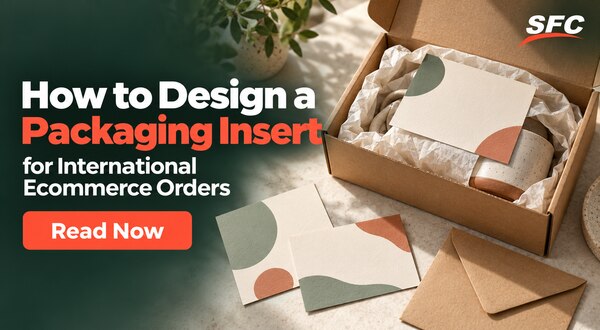
That card must look good, say something useful, work in the customer's language, and reach the correct order. Think of it as a tiny landing page that also has to behave like warehouse inventory.
This guide explains the whole process, from choosing the message to giving your 3PL a packing rule it can actually follow.
First, Be Clear About Which “Insert” You Mean
An ecommerce packaging insert is a printed card, leaflet, or small booklet placed inside an order. It may thank the buyer, explain care, help with setup, offer a discount, or direct the customer to support.
It is not automatically the same as a packing slip. It is also different from a molded pulp, foam, or corrugated insert that holds a product in place. Those protective pieces are part of the packaging structure.
Care cards and instruction leaflets can overlap. Some are optional customer-experience pieces. Others contain information a market or product category requires.
| Item | Main job | Typical owner | Usually optional? |
| Marketing or thank-you card | Build a relationship or drive an action | Brand or marketing team | Yes |
| Care or setup card | Help the customer use the product | Product or support team | It depends |
| Packing slip | Identify the order and its contents | Operations team | It depends on the workflow |
| Required warning or instruction | Support safety and compliance | Product or compliance team | Often no |
| Protective packaging insert | Hold and protect the item | Packaging engineer | Based on damage risk |
The distinction matters. A thank-you card can change with a campaign. A safety instruction should not be treated like seasonal ad copy.
Give the Card One Job Before You Pick a Size
Start with the outcome, not the artwork. What should the customer know or do after reading the insert?
Common goals include setup, care, registration, reorders, referrals, honest reviews, support, or returns guidance.
Pick one primary goal. A skincare card that explains a routine, asks for a review, sells a refill, and promotes Instagram feels like four shop assistants speaking at once.
Segmentation can make the message more useful. A separate card may be justified by product, language, destination, subscription month, customer type, or crowdfunding reward tier. Marketplace and DTC orders may also need different wording. Still, every new version must be approved, printed, stored, selected, and retired. Add one only when the message or packing rule genuinely changes.
Write the Insert Like a Helpful Human, Not a Mini Billboard
Most buyers scan first. Give the card an obvious order:
- A headline that states the benefit or task.
- Two or three short lines of useful detail.
- One clear call to action.
- Brand and support information in a quieter position.
For example, a reusable bottle card could say:
Keep your bottle fresh Rinse after use. Wash the lid separately. Let both parts dry before reassembly. For the full guide, scan the code or visit brand.com/care.
It is not clever. Good. It is easy to understand.
Keep stable, essential information in print. Put longer videos, changing FAQs, or replacement-part pages online. Do not hide critical safety information behind a QR code merely to clean up the design unless the relevant rules permit it.
Translation needs context. Give the translator the product, audience, space limit, and purpose. Then review the final artwork. German text may expand. Arabic changes the reading direction. Dates, units, humor, and support channels can also fail after literal translation. Localize the meaning, not just the nouns.
Choose a Format and Material That Fit the Parcel
A flat card works for one action. A folded leaflet gives instructions more room. A booklet suits a complicated product but becomes bulky. A sticker handles a batch note, seal, or reminder.
Business-card, A6, and postcard-like dimensions are common, but there is no universal best size. Measure the product and mailer. The piece should lie flat without blocking a seal, scratching the item, or forcing a larger parcel.
The card must suit the rest of your international ecommerce packing materials. An oversized card is a poor trade if it pushes a slim parcel into a larger format.
| Material | Useful qualities | Tradeoffs | Good fit |
| Uncoated card stock | Natural feel, readable, easy to write on | Marks and absorbs moisture more easily | Thank-you notes and premium handmade brands |
| Coated card stock | Sharp images and better scuff resistance | Glare can affect QR scanning; some finishes complicate recycling | Color-heavy brand and product cards |
| Recycled paper stock | Lower virgin-fiber use and a visible sustainability story | Shade and surface may vary | Minimal, natural, or eco-positioned packaging |
| Synthetic or moisture-resistant stock | Durable around water and oils | Higher cost and less suitable for paper recycling streams | Bathroom, kitchen, outdoor, or workshop products |
Ask the printer about thickness, stiffness, coating, recycled content, and recyclability. “Eco-friendly” alone says almost nothing. Also test whether ink rubs onto the product. It happens, and once is enough to ruin a white item.
Design for Real International Orders
There is no single “global customer.” A card used in California may need a different language, offer, unit, URL, or support channel in France or Japan.
Split the design into two layers. The universal layer holds the logo, image, icons, and brand voice. The local layer contains language, contact details, units, legal wording, dates, and the regional landing page.
Do not use a marketing card as a compliance shortcut
Product category and destination determine what must appear on the product, packaging, or accompanying documentation. The EU's General Product Safety Regulation, for example, includes identification, traceability, and safety-information duties for products within its scope.
That does not mean every requirement belongs on a promotional card. Treat mandatory warnings, labels, instructions, and traceability details as a separate compliance workstream. A removable insert may carry some information, but this must be checked by product and market. A nice layout is not legal analysis.
Review marketplace rules before printing thousands
A review request should be neutral. Do not reward only positive reviews or route unhappy buyers away from the review process. Do not use an insert to move marketplace customers off-platform when channel rules prohibit it.
Before print approval, product or compliance should check facts and claims. The marketplace owner checks channel policy. Support checks instructions and contact paths. Fulfillment confirms the correct version can be packed reliably.
This review is slower than approving artwork alone. It is faster than destroying cartons of outdated cards.
Make the QR Code Useful After the Print Run Is Paid For
A QR code saves space only if it continues to work. Point it to a brand-owned redirect so the final destination can change without reprinting. The landing page should load quickly on mobile and show the right language or a clear selector.
Print a short URL beside the code for customers who cannot scan.
Leave a clean quiet zone around the code and use strong contrast. Avoid folds, trimmed edges, reflections, and curves. Test the printed proof on several phones in normal indoor light. A code that works at 300% zoom on a monitor proves very little.
Use UTM parameters or a dedicated path to measure results. Assign someone to maintain the redirect after the campaign ends. ISO 22742:2026 covers linear barcodes and two-dimensional symbols for product packaging, but standards do not replace a print-and-scan test.
Prepare Artwork a Printer Can Actually Use
Ask the printer for its template before finishing the layout. “A6” or “postcard” does not mean every supplier uses identical production tolerances.
Print-file checklist
- Confirm the trim size and dieline.
- Extend backgrounds through the bleed.
- Keep important elements inside the safe area.
- Use CMYK if requested, and review how bright screen colors may shift in print.
- Supply images at the required resolution. A common target is 300 DPI at final size, but use the printer's specification.
- Outline or package fonts so they do not change unexpectedly.
- Remove hidden notes and outdated language layers.
- Use a filename such as INS-CARE-DE-R03-2026-10.pdf, not final-card-new-2.pdf.
Proof twice. A digital proof catches missing text, alignment problems, and the wrong revision. A physical proof reveals type size, paper feel, glare, color, and scanning behavior.
Then place the proof in a real parcel. Seal it, shake it, and open it as a customer would. The card may slide under the product or cover the first thing the buyer needs.

Turn the Approved Design Into a 3PL Packing Rule
Approval is not the end. The warehouse must identify, store, and select the piece correctly.
Give every version an insert SKU or controlled ID. Record its language, region, revision, compatible product SKUs, channel, dates, and substitution rule with the other product master data your 3PL needs.
Avoid “use the new German card for Europe.” Europe is not a language, and “new” soon becomes meaningless.
A better rule looks like this:
Add INS-CARE-DE-R03 to German DTC orders containing product family A from October 1. Add one per order. Do not use it for marketplace orders. Do not substitute the English version if German stock reaches zero.
Define what happens when two rules match. Does a setup card outrank a thank-you card? Can both be included? Is the quantity one per order, item, or kit?
For physical control, specify:
- the storage bin and visible language marker;
- whether the insert is scanned or confirmed on a checklist;
- its position and orientation inside the parcel;
- the sample used for packing QA;
- cycle-count frequency; and
- the process for quarantining expired versions.
A provider handling ecommerce fulfillment from China can connect the rules with product, channel, and destination data. Inserts, labeling, kitting, and custom packing also fit within value-added fulfillment services. Run a small batch and inspect several rule combinations before launch.
Calculate the Real Cost, Then Measure the Result
The printer's quote is one line of the budget. Total cost may include copy, design, translation, compliance review, prepress, proofs, freight, receiving, storage, insertion, kitting, damage, and leftover versions.
Large runs reduce unit price but make changes painful. If an offer, address, or claim may change, a smaller run or evergreen design can cost less overall. Inventory that must be destroyed was not cheap.
Measure the result that matches the card's job:
| Insert goal | Useful measures |
| Reorder or refill | Code redemption, repeat purchase rate, revenue per delivered card |
| Setup help | Guide visits, successful registrations, setup-related support tickets |
| Product care | Return reasons, damage complaints, care-page visits |
| Referral | Qualified referrals, first orders, acquisition cost |
| Review request | Completed reviews and rating distribution, where policy permits |
QR scans alone are not success. Scans without a useful next step may mean the card created confusion.
When volume allows, keep a holdout group with no insert. If that is impractical, compare defined periods while noting changes in price, traffic, delivery time, and product mix.
Common Insert Problems and the Fix That Usually Works
| Problem | Likely cause | Practical fix |
| Customers ignore the card | Too many messages compete for attention | Keep one primary action |
| The QR code will not scan | Low contrast, glare, fold, or a code printed too small | Test a physical proof and add a short URL |
| The wrong language is packed | Versions look alike or the order rule is vague | Use separate IDs, large language marks, and explicit system logic |
| An expired offer reaches customers | No end date or obsolete-stock control | Add validity dates and quarantine old stock |
| The warehouse misses the insert | It is outside the pick and QC flow | Create a scannable SKU or required checklist step |
| The card creates complaints | Copy conflicts with product facts or platform policy | Require product, channel, support, and fulfillment approval |
How Insert Priorities Change by Industry
| Industry | Useful insert focus | Extra caution |
| Beauty and personal care | Routine, patch-test direction, refill path | Claims, ingredients, and local cosmetics rules |
| Apparel and accessories | Care, fit help, exchanges | Fiber and care information may have separate requirements |
| Consumer electronics | Setup, support, warranty route | Electrical safety, batteries, e-waste, and radio requirements |
| Food and supplements | Serving guidance and brand story | Required food and health information should not be moved casually |
| Toys, hobbies, and board games | Assembly, component list, community | Age grading, warnings, and missing-part support |
| Subscription boxes | Theme, item guide, preview of the next box | Monthly batch accuracy and revision control |
| Crowdfunding rewards | Setup, backer thanks, support route | Reward-tier and production-batch matching |
Final Preflight Checklist Before Mass Printing
- The insert has one primary purpose and action.
- Product facts and claims are approved.
- Market and sales-channel requirements have been reviewed.
- Translation has been checked in the final artwork.
- Size, stock, finish, bleed, and safe area are confirmed.
- The printed QR code and fallback URL both work.
- Insert ID, revision, start date, and end date are recorded.
- Packing rules have been tested with sample orders.
- Expired and obsolete stock has a quarantine process.
- Measurement is ready before the first card ships.
Conclusion
The best packaging insert is not the one with the most information. It is the one customers understand and a warehouse packs correctly, again and again.
Keep the message focused. Localize what changes. Test the printed piece in a real parcel and control every version like inventory. For products made in China, branded packaging fulfillment in China can connect printing, insert control, packing, and international delivery.
Frequently Asked Questions
What is a packaging insert in ecommerce?
It is a printed card, leaflet, booklet, sample, or promotional piece placed inside an order. It may thank the buyer, explain care or setup, share support details, encourage a reorder, or request a review where permitted.
What is the difference between a packaging insert and a packing slip?
A packing slip records order details such as items and quantities. A packaging insert supports communication, education, or marketing. They may share a parcel, but they have different data and approval processes.
What size should an ecommerce insert card be?
There is no single best size. Business-card, A6, and postcard-like formats are common. It should fit flat in the actual mailer, keep text readable, and not force a larger parcel. Test it with the product.
What should a thank-you card inside an international order say?
Keep it warm and short. Thank the buyer, give one useful next step, and show a clear support route. Avoid slang that translates badly. Display promotion restrictions and expiry dates clearly.
Can a QR code replace printed product instructions?
Not automatically. QR codes suit videos and extended guidance, but rules may require safety, traceability, or instruction content on the product, packaging, or accompanying document. Check the product and destination before removing print.
How should a brand handle several languages on one insert?
For short messages, one multilingual card may work. Longer copy is often clearer in separate versions. Give each one a unique ID and visible language marker, then connect it to destination or customer-language data.
Which paper or card stock is best for package inserts?
Uncoated stock suits natural designs and notes. Coated stock gives sharper images. Recycled paper supports a lower-material-impact story, while moisture-resistant stock suits wet environments. Choose by product, parcel, disposal route, and budget.
Can a marketplace insert ask for a review or offer a discount?
Sometimes, but wording matters. Do not pressure buyers or reward only positive reviews. Discounts, redirection, and off-platform contact may also be restricted. Check the marketplace's current policy before printing.
How much do custom packaging inserts cost, and what affects the MOQ?
Cost depends on size, paper, color, finish, folding, quantity, proofing, and setup. Translation, freight, storage, and insertion also count. MOQ varies by production method and supplier, so compare total landed and fulfillment cost.
How can a brand track whether packaging inserts work?
Use a dedicated discount code, short URL, QR path, or UTM-tagged landing page. Match the metric to the goal, such as repeat orders, registrations, referrals, or fewer support tickets. A holdout group provides a cleaner comparison when order volume permits.
 Post Views:8
 TAGS:
TAGS:
Copyright statement: The copyright of this article belongs to the original author. Please indicate the source for reprinting.
Previous Post
Next Post
What Is a China Fulfillment Center and How to Use It? A Comprehensive Guide
TAGS
Hot Research
Recent News
Get Custom eCommerce Fulfillment Service
Book a Meeting
Get a Custom China Fulfillment Solution with FREE Storage for 30 Days
Want to know about our services, fees or receive a custom quote?
 Want to know about our services, fees or receive a custom quote?
Please fill out the form on the right and we will get back to you within a business day.
The more information you provide, the better our initial response will be.