




Table of Contents
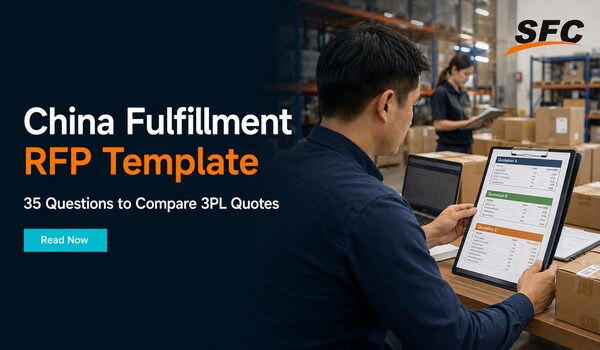
China Fulfillment RFP Template: 35 Questions to Compare 3PL Quotes
Time: Aug 27,2026 Author: SFC Source: www.sendfromchina.com
- company fit and China experience;
- supplier inbound and receiving;
- storage and inventory handling;
- packaging and shipping costs;
- technology and reporting;
- service levels, returns, and risk;
- commercial terms, governance, and exit.
What Is a China Fulfillment RFP?
|
Term
|
Meaning
|
When to Use It
|
|
RFI
|
Request for information
|
When you are learning which providers and capabilities exist
|
|
RFQ
|
Request for quotation
|
When the scope is clear and you mainly need comparable pricing
|
|
RFP
|
Request for proposal
|
When you want both a solution design and a commercial proposal
|

Send the Same Data Pack to Every 3PL
Product and Packaging Data
- SKU and product name;
- product photos;
- unit weight and packed weight;
- product and packed dimensions;
- master-carton dimensions and quantity;
- product material;
- fragile, liquid, battery, magnet, or other restricted-item status;
- current packaging and desired packaging;
- insert, bundle, kitting, and labeling requirements.
Order and Inventory Profile
- active SKU count;
- monthly orders;
- monthly order lines;
- average units per order;
- single-item versus multi-item order percentage;
- bundles and subscription orders;
- expected returns;
- average and peak inventory;
- supplier inbound frequency;
- promotional or launch periods.
Destination and Service Profile
- destination-country and postcode mix;
- required delivery windows;
- preferred shipping services;
- marketplace and DTC channels;
- tracking expectations;
- return destination;
- DDP, DAP, or other delivery-term preference;
- expected peak volume;
- current problem areas.
The 35 Questions to Include in Your China Fulfillment RFP
A. Company Fit and China Fulfillment Experience

1. Which ecommerce categories and product profiles do you handle most often from China?
2. How many active clients and monthly orders does the proposed facility support, and how many are in our volume range?
3. Which facility will handle our inventory, and what capacity is currently available?
4. How do you support supplier consolidation, inbound receiving, quality checks, and export preparation in China?
5. Can you provide two relevant client references or anonymized performance examples?
B. Scope of Work and Inbound Operations

6. What exactly is included in receiving, and how is it billed?
7. How do you handle mixed-SKU cartons, missing labels, quantity discrepancies, damaged stock, and non-compliant inbound shipments?
8. What inspection, photography, relabeling, repacking, kitting, or assembly services are available?
9. What is the standard inbound processing time from arrival to available inventory?
10. Which packaging materials, product information, carton labels, and supplier documents must we provide?
C. Storage, Inventory, and Handling Fees

11. How is storage measured and billed?
12. Are there minimum storage charges, account minimums, seasonal adjustments, or long-term-storage fees?
13. How are slow-moving, damaged, quarantined, promotional, or obsolete products handled?
14. What inventory accuracy target, cycle-count process, and discrepancy workflow do you provide?
15. How are first-item picks, additional-item picks, bundles, inserts, and special handling priced?
D. Packaging, Shipping, and Total Cost

16. What packaging is included in pick-and-pack, and what is charged separately?
17. Are shipping rates based on actual weight, dimensional weight, billable weight, zone, service, or a carrier table?
18. Which fuel, remote-area, residential, oversize, peak, address-correction, or special-handling surcharges can apply?
19. Do you pass through carrier rates at cost, apply a markup, or use bundled shipping prices?
20. Can you quote our exact sample order profile as an all-in cost per successfully delivered order?
E. Technology, Visibility, and Data

21. Which ecommerce platforms, marketplaces, ERP, OMS, WMS, and APIs do you support?
22. What order, inventory, tracking, shipment, exception, and report data can we access?
23. How do you prevent duplicate orders, overselling, incorrect SKU mapping, and failed tracking updates?
24. What is included in integration, onboarding, testing, maintenance, and custom development?
25. Can you provide a sample dashboard or anonymized report?
F. Service Levels, Returns, and Risk Control
26. What same-day or next-business-day dispatch cutoff can you commit to?
27. Which KPIs and SLA remedies apply to accuracy, inventory, dispatch, handoff, claims, and support?
28. How do you handle lost, damaged, delayed, refused, or returned parcels?
29. How are international returns received, inspected, restocked, repacked, disposed of, or consolidated?
30. What contingency plans cover peak volume, system outage, labor disruption, weather, customs delay, or carrier capacity limits?
G. Commercial Terms, Governance, and Exit

31. What monthly minimums, setup fees, account fees, deposits, or storage commitments apply?
32. How often can rates change, what notice is required, and which fees are indexed or passed through?
33. What contract term, renewal, termination, inventory-release, data-export, and transition provisions apply?
34. How are billing disputes, service failures, credits, claims, and scope changes resolved?
35. Who owns the operating relationship, how often is performance reviewed, and what information is needed for a final quote?
How to Compare 3PL Quotes Without Getting Tricked by the Rate Card
|
Quote Line
|
Provider A
|
Provider B
|
Provider C
|
Comparison Rule
|
|
Receiving
|
|
|
|
Same inbound unit and exception assumptions
|
|
Storage
|
|
|
|
Same measurement method and billing period
|
|
First pick
|
|
|
|
Same single-item order example
|
|
Additional pick
|
|
|
|
Same multi-item order example
|
|
Packaging
|
|
|
|
Same material specification
|
|
Shipping
|
|
|
|
Same route, service, dimensions, and weight
|
|
Surcharges
|
|
|
|
Require trigger list and calculation method
|
|
Returns
|
|
|
|
Same inspection and restock assumptions
|
|
Technology
|
|
|
Separate included and paid integration work
|
|
|
Minimums
|
|
|
|
Apply the same monthly volume scenario
|
|
All-in sample order
|
|
|
|
Include known and expected exception costs
|
Worked Illustrative Example
- one receiving allocation of $0.20;
- one month of storage allocation at $0.35;
- first pick and pack of $1.40;
- packaging at $0.55;
- shipping at $8.80;
- expected surcharge allocation of $0.70;
- expected return and exception allocation of $0.45.
Score Responses With Cost and Fit in the Same Model
|
Category
|
Suggested Weight
|
Why It Matters
|
|
All-in cost and billing transparency
|
25%
|
Prevents a low headline rate from hiding total expense
|
|
Operational fit and capacity
|
20%
|
Shows whether the provider can handle the product and volume
|
|
Delivery, accuracy, and SLA quality
|
20%
|
Protects customer experience and revenue
|
|
Technology and visibility
|
15%
|
Reduces manual work and improves exception control
|
|
China-origin capability
|
10%
|
Matters for suppliers, inbound, export, and cross-border work
|
|
Contract, risk, and exit terms
|
10%
|
Protects the business if performance or strategy changes
|
- 1: Does not meet the requirement or gives no usable evidence.
- 2: Partial fit with material limitations.
- 3: Meets the basic requirement.
- 4: Strong fit with evidence and a clear process.
- 5: Excellent fit with relevant proof, measurable commitment, and low implementation risk.
Red Flags in a China 3PL RFP Response
|
Red Flag
|
Why It Matters
|
Follow-Up Request
|
|
“Shipping starts at…” with no route or dimensions
|
The number cannot be compared
|
Request an all-in sample order
|
|
Storage price with no measurement method
|
Pallet, bin, shelf, and cubic-meter costs differ
|
Ask for formula and sample month
|
|
“All-inclusive” with no exclusions
|
Hidden fees may appear later
|
Request a full inclusion and exclusion list
|
|
No current surcharge list
|
Fuel, remote, peak, and oversize charges remain unknown
|
Ask for trigger and effective-date rules
|
|
No named facility or capacity figure
|
The proposed operation is unclear
|
Request facility, capacity, and walkthrough
|
|
No SLA definitions
|
“Fast” and “accurate” cannot be audited
|
Request formulas and timestamps
|
|
No inventory-discrepancy process
|
Stock errors can become your problem
|
Request cycle-count and claim workflow
|
|
No return or exit process
|
A future migration may be expensive
|
Request release and transition terms
|
|
Refusal to show reports
|
Visibility claims cannot be checked
|
Ask for anonymized dashboard examples
|
|
Extremely low pricing with vague answers
|
The quote may omit labor or exceptions
|
Rebuild the all-in scenario
|
From RFP to Pilot: The Final Selection Process
Shortlist Three to Five Providers
Verify the Facility and Process
Run a Controlled Pilot
- receiving time;
- inventory accuracy;
- order accuracy;
- dispatch time;
- tracking updates;
- damage;
- support response;
- invoice accuracy;
- actual shipping and surcharge treatment.
Negotiate After the Assumptions Are Clear
China-Specific Questions Generic 3PL Templates Miss
- Can several suppliers deliver to one origin warehouse under a common inbound standard?
- Can the provider consolidate cartons from multiple factories?
- Who performs product inspection and handles discrepancies?
- Who prepares export-ready packaging and documentation?
- How are batteries, liquids, magnets, cosmetics, and branded goods handled?
- Who owns HS code and customs-description data?
- Which DDP, DAP, or DDU assumptions are included?
- Where do international returns go?
- How are factory shutdowns and origin peaks handled?
- Can the provider release inventory and data during a transition?
A Copy-and-Paste RFP Checklist
- The same product and order data goes to each provider.
- Packed dimensions and actual weights are verified.
- Supplier inbound and consolidation requirements are defined.
- Every fee unit and minimum is disclosed.
- Shipping routes and service levels are standardized.
- Surcharges and carrier markups are identified.
- Returns, claims, and exceptions are included.
- Systems and data access are documented.
- SLA targets and evidence are agreed.
- Exit and inventory-release terms are reviewed.
- Quotes are normalized into an all-in sample-order cost.
- Responses are scored on cost, fit, service, technology, and risk.
Conclusion
FAQs
1. What is a China fulfillment RFP?
2. What is the difference between an RFP and an RFQ for 3PL services?
3. How many 3PLs should receive a fulfillment RFP?
4. What information do China 3PLs need to prepare an accurate quote?
5. Which fulfillment fees should appear in a China 3PL quote?
6. How do I compare storage fees from different fulfillment providers?
7. Should shipping be included in the 3PL RFP?
8. How do I score China 3PL proposals?
9. What are the biggest red flags in a 3PL quote?
10. Should I run a pilot before signing a China fulfillment contract?
 Post Views:1660
 TAGS:
TAGS:
Copyright statement: The copyright of this article belongs to the original author. Please indicate the source for reprinting.
Previous Post
Safety Stock for Ecommerce: How Much Inventory Should You Hold in China?
Next Post
Shipping Surcharges From China: Fuel, Remote Area, Oversize, and Peak Fees
TAGS
Hot Research
Get a Custom China Fulfillment Solution with FREE Storage for 30 Days
Want to know about our services, fees or receive a custom quote?
 Want to know about our services, fees or receive a custom quote?
Please fill out the form on the right and we will get back to you within a business day.
The more information you provide, the better our initial response will be.