




Table of Contents
Get Custom eCommerce Fulfillment Service
Book a Meeting
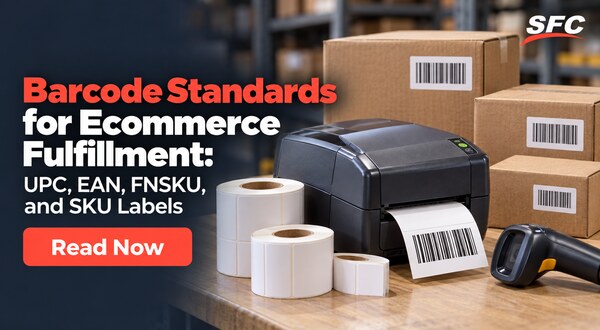
Barcode Standards for Ecommerce Fulfillment: UPC, EAN, FNSKU, and SKU Labels
Time: Oct 08,2026 Author: SFC Source: www.sendfromchina.com
A black 350 ml mug may have a brand SKU, UPC, Amazon seller SKU, ASIN and FNSKU. Each code answers a different question.
Think about a person. Your name, passport number, employee ID, and hotel key can all belong to you. Handing your hotel key to border control will not go well, though.
Barcodes work the same way. One product can have several valid identities, but every scanner must read the one its system expects.
Start With the Difference Between an Identifier, a Barcode and a Label
People often use these words as if they mean the same thing. They do not.
An identifier is data assigned to something. A GTIN identifies a trade item, an SKU identifies an internal record, and an FNSKU identifies inventory in an Amazon FBA workflow.
A barcode symbology is the visual language carrying the data. UPC-A, EAN-13, Code 128 and ITF-14 are examples. The bars are a machine-readable way to enter an identifier into a system.
A label is the physical piece stuck to a box, polybag or product. It has facestock, adhesive and print. Barcodes can also be printed directly on packaging.
So “the factory already added a barcode” is incomplete. Ask:
- What value does it encode?
- Which symbology is used?
- Which packaging level does it identify?
- Which system will look up the scan?
The scanner can work perfectly while the workflow fails.
UPC, EAN, SKU and FNSKU at a Glance
The GS1 explanation of GTINs and barcodes separates the global product identifier from the symbol carrying it. That distinction clears up much of the confusion.
| Code | Who controls it | What it identifies | Common carrier | Typical use |
| GTIN-12, commonly called UPC | Brand owner through GS1 | A trade-item variant | UPC-A symbol | North American retail and marketplaces |
| GTIN-13, commonly called EAN | Brand owner through GS1 | A trade-item variant | EAN-13 symbol | Retail in many markets outside North America |
| Internal SKU | The business | Its own inventory record | Text or a supported barcode such as Code 128 | Store, ERP, WMS and 3PL operations |
| Seller SKU | Marketplace seller | The seller's offer record | Mainly system data | Channel and listing management |
| ASIN | Amazon | An Amazon catalog product or variation | Mainly system data | Amazon product catalog |
| FNSKU | Amazon | Seller-specific inventory in an FBA workflow | Amazon barcode label | Amazon fulfillment tracking |
These codes can coexist. A product may use a UPC globally, an SKU in the warehouse and an FNSKU for Amazon.
UPC and EAN Are Product Identities, Not Warehouse Nicknames
A UPC is generally a 12-digit GTIN carried in UPC-A. An EAN is generally a 13-digit GTIN carried in EAN-13. UPC is common in North America; EAN-13 is common elsewhere. Modern systems often support both.
The prefix does not reliably show where a product was made. It relates to number allocation, not necessarily the factory's country.
Each traded variation needs the correct identity under GS1 rules. A blue medium shirt and a blue large shirt differ, as do a single bottle and a two-pack. Reusing one GTIN is like giving two apartments the same mailbox number.
The final check digit helps detect common errors. Store the entire value as text. If a spreadsheet removes a leading zero, the identifier has changed.
A DTC-only brand may use internal SKUs when its systems do not require GTINs. Retailers, marketplaces and product feeds may require standardized identifiers later.

Build SKU Labels for People and Warehouse Systems
An SKU is yours to create. It should remain stable while the item exists.
A useful pattern might be MUG-350-BLK: product family, capacity and color. Compare that with NEW-MUG-FACTORY2-$12. The second code becomes wrong as soon as the item is no longer new, the supplier changes or the price moves.
Good internal SKUs are:
- unique to one sellable variant;
- short enough for labels and integrations;
- readable by warehouse staff;
- free from spaces and troublesome symbols;
- independent of price, supplier and location; and
- never reassigned.
Similar abbreviations such as BLK, BLU and BRN should be backed by clear descriptions and photos.
Printing SKU text does not make it scannable. If the WMS expects an alphanumeric SKU in Code 128, generate and test that format. Another warehouse may expect a GTIN. Ask first. A barcode without a matching record is decoration.

FNSKU Rules for Amazon FBA in 2026
UPC or EAN and FNSKU solve different problems. The manufacturer barcode identifies the product. The FNSKU connects eligible physical inventory to a seller's FBA record.
Amazon changed its policy on March 31, 2026. Current FBA barcode requirements say eligible brand owners can continue using manufacturer barcodes without stickers, while resellers use Amazon barcodes. Product, marketplace and account eligibility still matter.
Do not print 20,000 labels because an old tutorial says every FBA unit needs one. Nor should you assume Brand Registry makes every shipment sticker-free. Check the live Send to Amazon workflow.
When an FNSKU is required:
- use the label generated for the correct seller SKU;
- apply it flat to the outside of the sellable unit;
- make competing scannable product codes inaccessible as Amazon instructs;
- keep the human-readable information clear;
- confirm it remains visible after polybagging or bundling; and
- do not cover expiry dates, lot codes, warnings or required regulatory text.
If two retail barcodes remain visible, covering one may not solve the problem. Review the whole package. SendFromChina's Amazon FBA labeling requirements guide covers the wider preparation context.
Choose a Label Material That Survives the Journey
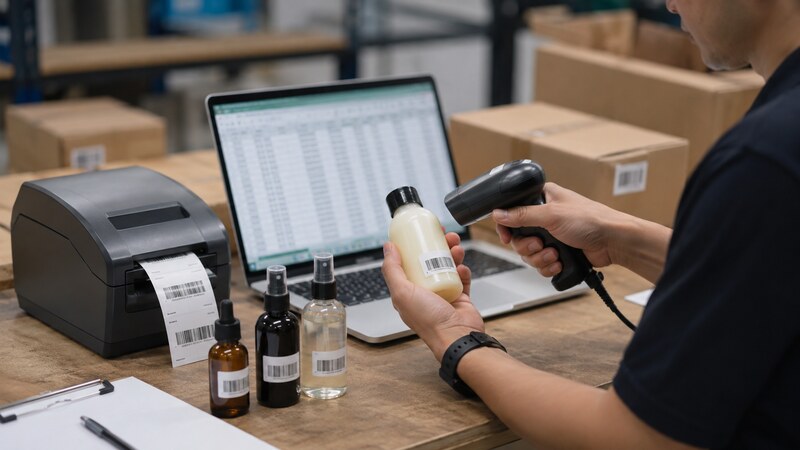
A label combines facestock, adhesive, ink or ribbon, product surface, temperature and storage time. Change one part and the result may change.
| Label option | Strengths | Weaknesses | Good fit |
| Direct print on packaging | No application step; durable when produced well | Artwork changes require new packaging | Stable retail products |
| Direct thermal paper | Fast and economical; no ribbon | Heat, light and abrasion can reduce readability | Short-life indoor labels |
| Thermal transfer paper | Sharp and more durable | Requires the correct ribbon and setup | General warehouse and FBA prep |
| Synthetic film | Resists moisture, oil and tearing | Higher cost; recycling may be less simple | Cosmetics, chilled goods and harsh handling |
| Removable adhesive | Easier to remove or replace | May lift from difficult surfaces | Temporary channel labels where accepted |
| Permanent adhesive | Stronger long-term bond | Corrections are harder | Long-life identification on tested surfaces |
Paper may suit corrugated cases but fail on an oily jar or cold container. Some plastics reject adhesive that bonds well to cardboard.
Test the label on the real surface. Rub it, chill it if needed, age it, then scan it. Not glamorous, but cheaper than relabeling stock.
Print and Place Barcodes for Scanners, Not Mockups
A barcode can look sharp on screen and scan badly in print. GS1 placement and printing guidance stresses good artwork, print quality, colors, proportional sizing and quiet zones.
Use dark bars on a light background. Black on white is boring—and good. Avoid red bars, low contrast and reflections. Do not stretch artwork, crop quiet zones or shorten bars to gain space.
Placement matters too. Avoid:
- folds, seams and package edges;
- tight curves on bottles or tubes;
- shrink-wrap wrinkles and polybag seals;
- carton straps and tape paths; and
- areas hidden after final packing.
Keep the human-readable value visible so staff can investigate failed scans.
Test the actual print run with factory and 3PL devices under normal lighting. Important retail programs may require formal verification. One successful phone scan does not prove compliance with the applicable specification.
Map Each Barcode to the Correct Packaging Level
One spreadsheet column named barcode becomes messy as soon as a warehouse handles more than single units.
| Packaging level | Possible identifier | Scan purpose | Common mistake |
| Sellable unit | GTIN, internal SKU or FNSKU | Receive, pick, pack, retail or FBA | Two variants share one code |
| Inner pack | Separate GTIN or controlled internal code | Replenishment and counting | Pack is mistaken for one consumer unit |
| Case | GTIN-14, ITF-14, GS1-128 or 3PL carton ID | Receiving and case handling | Case code is stored as the unit barcode |
| Pallet | SSCC on a logistics label | Shipment and pallet tracking | One pallet identity is reused |
| Bin or location | WMS location code | Putaway and pick confirmation | Location label looks like a product label |
The choice depends on the channel and WMS. Keep levels separate: a case code for 24 mugs must not tell the system that one mug arrived.
Give Your 3PL a Barcode Map, Not a Folder of PDFs
Artwork does not explain how identifiers relate. Build a structured map with the other product master data your 3PL needs.
For each item, record:
- internal warehouse SKU, product name and variant;
- GTIN type and complete value;
- unit barcode symbology;
- seller or channel SKU;
- ASIN and FNSKU where applicable;
- unit, inner-pack, case and pallet relationships;
- quantity at each packaging level;
- approved artwork and revision;
- who applies the label and where;
- effective and retirement dates;
- current product and packaging photos; and
- lot, expiry or serial-number rules when required.
Before stock arrives, scan a sample unit and case into the WMS. Confirm that imports preserve leading zeros and check digits. Scan similar variants side by side to catch swapped artwork.
Define what happens when a label is missing, unreadable, duplicated or unexpected. Use quarantine, photo evidence, approval and controlled relabeling. “Staff will figure it out” is not an SOP.
Put Barcode Scans at the Right Warehouse Checkpoints
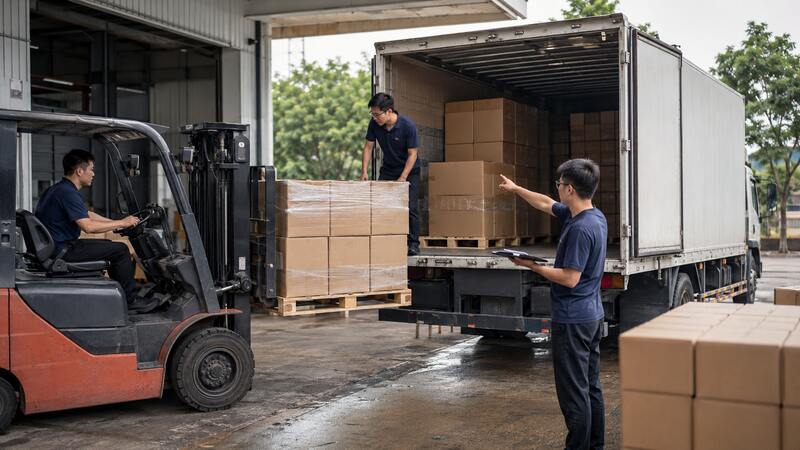
At receiving, scan the item against the expected SKU. Scan the destination during putaway to confirm what arrived and where it went.
During barcode-verified pick and pack, scan the location, item and quantity. A pack-station scan helps with look-alike variants and high-risk products.
On return, the barcode identifies the item but not whether it is damaged or resellable. Record condition separately.
Use cycle counts and error logs to find mapping failures. Strong inventory accuracy controls compare identity, quantity, location and status—not merely whether the scanner beeped.
Common Barcode Problems and Practical Fixes
| Problem | Likely cause | Practical fix |
| Digits scan but the WMS finds nothing | Value is missing or stored in the wrong field | Map it to the correct SKU and packaging level |
| Leading zero disappears | Spreadsheet treats the identifier as a number | Store the field as text and validate imports |
| FNSKU unit scans as a UPC | Another product code remains visible | Follow the live Amazon workflow and obscure competing codes when required |
| Label does not scan | Poor contrast, missing quiet zone, damage or glare | Reprint approved artwork and test production samples |
| Two variants share one label | Catalog or factory artwork error | Quarantine inventory and rebuild the one-code-to-one-variant map |
| Case is received as one unit | Unit and case identities are confused | Create separate packaging-level records and rules |
| Old code remains in circulation | No revision or cutover control | Use effective dates, quarantine and a relabeling plan |
Barcode Priorities Change by Industry and Channel
| Industry or model | Barcode priority | Extra control |
| Apparel and footwear | Distinct size and color variants | Scan look-alike variants at packing |
| Beauty and cosmetics | Unit identity plus lot or expiry where needed | Use material that tolerates oil and handling |
| Food and supplements | Product, pack count, batch and expiry | Do not cover required consumer information |
| Electronics | SKU and GTIN may coexist with serial numbers | Keep product identity separate from unit serialization |
| Books and media | ISBN or another category identifier | Match the edition and format |
| Bundles and kits | Finished-kit identity plus component records | Stop component codes from overriding the kit |
| Amazon FBA | Manufacturer or Amazon barcode according to eligibility | Validate the live inbound workflow |
| DTC subscriptions | Stable SKU and pack-rule mapping | Control monthly kit versions |
Decide Who Owns Each Label Before Production
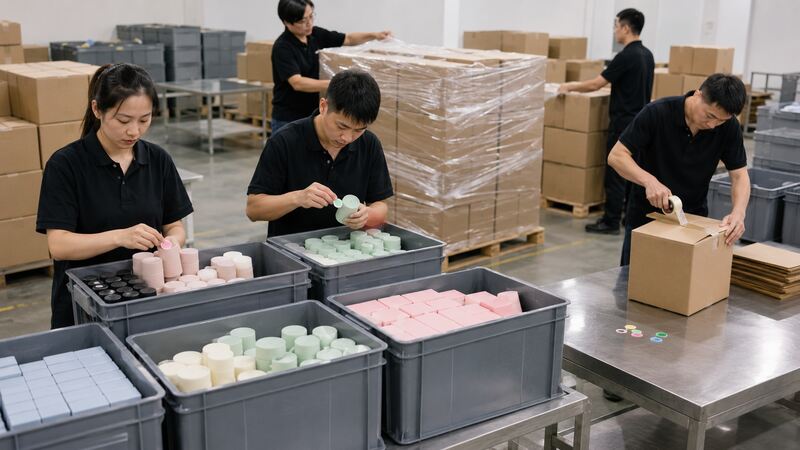
The brand owns product identity and data approval. The factory may print stable packaging. The channel defines acceptance rules. A China 3PL can inspect, relabel, apply FNSKUs, build kits and prepare cartons when contracted.
Production printing is usually cheaper than later unit labeling. Warehouse application fits changing channel rules, shared global inventory or unreliable factory control.
Define the owner, fee, material, artwork, scan test and rejection process. An Amazon FBA prep service in China can inspect or relabel inventory before international inbound shipping.
Barcode Launch Checklist
- Every sellable variant has one approved internal SKU.
- GTIN ownership and channel requirements are confirmed.
- Amazon barcode eligibility is checked in the live account.
- Unit, inner, case, pallet and location codes are separate.
- Barcode values are stored as text and mapped correctly.
- Label material matches the surface and environment.
- Artwork preserves contrast, size and quiet zones.
- Codes remain visible after final preparation.
- Factory and 3PL samples have been scanned.
- Cutover, quarantine, relabeling and exception rules are documented.
Conclusion
One product can have several valid identities. Trouble starts when the factory, marketplace and 3PL assume those identities are interchangeable.
Build the identifier map first. Then choose format, material, placement and scan points. Test every packaging level. A little discipline before receiving saves manual checks, relabeling fees and odd inventory errors later.
Frequently Asked Questions
What is the difference between a SKU, UPC, EAN and FNSKU?
A SKU is an internal business identifier. UPC and EAN are common names for standardized GTIN formats used across retail and marketplaces. An FNSKU is an Amazon identifier used for seller-specific inventory in eligible FBA workflows. They may all refer to the same product from different systems.
Is a UPC the same as a barcode?
Not exactly. A UPC generally refers to the GTIN-12 product identifier, while UPC-A is the barcode symbology commonly used to display it. In casual speech people combine the terms, but separating the number from its visual carrier prevents data and artwork mistakes.
Can the same product use both a UPC and an FNSKU?
Yes. A UPC may identify the product in a retail catalog, while an FNSKU identifies seller-specific inventory inside an Amazon FBA workflow. When Amazon requires the FNSKU on the unit, follow its instructions about other visible scannable product codes.
Do I need a UPC or EAN for a Shopify store?
Shopify can manage products with internal SKUs, so a DTC-only store does not automatically need a GTIN. A UPC or EAN may still be required by marketplaces, retailers, product feeds or wholesale partners connected to the store.
Does every product variant need a different UPC or EAN?
Usually, separately traded variants such as size, color, flavor or pack count need distinct GTINs under GS1 management rules. Check the current standard for the specific change. Do not assign one product identity to two variants merely because their packaging looks similar.
Do Amazon FBA sellers still need FNSKU labels in 2026?
It depends. Under Amazon's March 31, 2026 change, eligible brand owners may use manufacturer barcodes without stickers, while resellers use Amazon barcodes. Product and account eligibility still apply. Check the barcode type shown in the live shipment workflow.
Should an FNSKU label cover the UPC or EAN?
When Amazon requires an FNSKU, competing scannable unit barcodes generally need to be made inaccessible according to the current preparation instructions. Review the whole package, including codes revealed through a polybag. Never cover required warnings, expiry dates or regulatory information.
Can I create a barcode from my internal SKU?
Yes, if your WMS supports a suitable symbology such as Code 128. That makes the SKU scannable inside your operation; it does not turn the SKU into a GS1 GTIN. Confirm the exact value and format with your 3PL before printing.
What label size and material should I use for warehouse barcodes?
There is no universal size. It depends on the symbology, data length, scanner, print resolution, surface and channel rules. Use the applicable specification and test the finished label. Thermal-transfer paper suits many indoor uses; synthetic stock is better for moisture, oil or abrasion.
Why does a barcode scan correctly but fail in the 3PL's WMS?
The scanner may read the characters correctly while the WMS has no matching value, expects another field, or treats the code as a case instead of a unit. Compare the scan output with the approved barcode map and packaging-level record.
 Post Views:6
 TAGS:
TAGS:
Copyright statement: The copyright of this article belongs to the original author. Please indicate the source for reprinting.
Previous Post
Next Post
How to Design a Packaging Insert for International Ecommerce Orders
TAGS
Hot Research
Recent News
Get Custom eCommerce Fulfillment Service
Book a Meeting
Get a Custom China Fulfillment Solution with FREE Storage for 30 Days
Want to know about our services, fees or receive a custom quote?
 Want to know about our services, fees or receive a custom quote?
Please fill out the form on the right and we will get back to you within a business day.
The more information you provide, the better our initial response will be.