




Table of Contents
Get Custom eCommerce Fulfillment Service
Book a Meeting
Packing List vs. Commercial Invoice: What Is the Difference?
Time: Oct 10,2026 Author: SFC Source: www.sendfromchina.com
Two documents often travel with the same shipment, so it is easy to assume they are duplicates.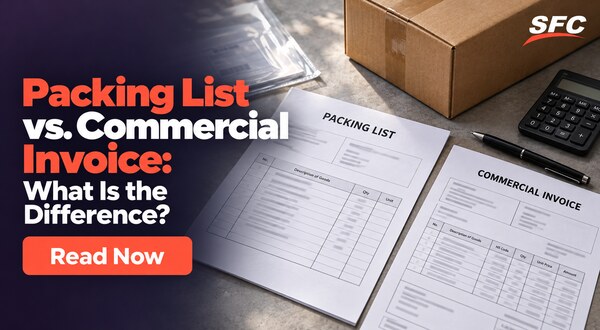
They are not.
The commercial invoice tells the transaction and customs story: who is selling, who is buying, what the goods are worth, where they originated, and which trade terms apply.
The packing list tells the physical packing story: how many cartons there are, what sits in each carton, how much each package weighs, and how the shipment is arranged.
One is closer to the shipment's financial and customs identity. The other is closer to its warehouse map. They overlap in a few places, but each has a different job.
That difference becomes important when shipping ecommerce orders from China. A parcel can have the correct products and still be delayed because the invoice says 10 units while the packing list says 12. Or the two documents may list the same order but show different carton counts, weights, or origins.
This guide explains what each document does, which fields belong where, how they should match, and how a China fulfillment center can generate both without turning the packing bench into a paperwork guessing game.
What Is a Packing List?
An export packing list is a physical shipment document. It describes how goods are packed inside cartons, pallets, cases, or other packages.
Depending on the shipment, it may show:
- Package or carton numbers.
- Pallet, skid, or container references.
- Product descriptions and SKUs.
- Quantity by package.
- Inner-pack quantity.
- Net weight by line or package.
- Gross weight by package.
- Package dimensions.
- Cubic measurement or CBM where useful.
- Marks and numbers.
- Packing method and handling notes.
- Total package count and total weight.
The warehouse uses it to pack and check the shipment. The carrier can use it to understand the physical load. The buyer, broker, customs officer, and receiving team may use it to locate and verify goods.
Packing List vs. Customer Packing Slip
This is where ecommerce language gets a bit slippery.
A customer packing slip normally goes inside an order and tells the recipient what should be in the parcel. It may show the order number, customer name, SKU, product title, and quantity. It usually does not contain detailed customs values, package dimensions, or export information.
An export packing list is built for the shipment and its physical handling. It can cover multiple cartons, pallets, inner packs, weights, dimensions, and package-level contents.
Some platforms use the phrase “packing slip” loosely. Always check the audience and purpose instead of relying on the document title alone.

What Is a Commercial Invoice?
A commercial invoice is a transaction and customs document used for international shipments of goods. It identifies the parties, goods, values, origins, quantities, currency, and trade terms connected with the movement.
Customs authorities and brokers may use it to assess duties and taxes, review admissibility, and process the import entry. The buyer and seller may use it as a record of the commercial transaction. The carrier may use it to support clearance.
The exact requirements vary by destination, carrier, commodity, transport mode, and transaction. The U.S. International Trade Administration notes that countries can specify their own form, content, copies, language, and other requirements. Its commercial invoice guidance is useful general context, but it does not replace destination-specific advice.
Common commercial invoice fields include:
- Invoice number and date.
- Seller and exporter details.
- Buyer, consignee, importer, and ship-to information.
- Order, shipment, or tracking references.
- Reason for export.
- Detailed product descriptions.
- SKU, model, or part number.
- HS classification where required or requested.
- Country of origin.
- Quantity and unit of measure.
- Unit value, line value, currency, and total value.
- Freight, insurance, discounts, and other relevant charges.
- Incoterm and named place.
- Package count and weights where required or useful.
- Declaration, signature, stamp, or other identifiers where applicable.
For a brand using ecommerce fulfillment in China, the 3PL may generate the invoice. But the brand, exporter, importer, and other trade parties still need to provide truthful, supportable data.

Packing List vs. Commercial Invoice: The Side-by-Side Difference
Here is the short version.
|
Question
|
Commercial invoice
|
Packing list
|
|
What is it mainly for?
|
Transaction, customs, value, origin, and trade terms
|
Physical packing and shipment handling
|
|
Who uses it?
|
Customs, broker, importer, buyer, seller, and carrier
|
Warehouse, carrier, buyer, customs, and receiving team
|
|
Does it show price?
|
Normally yes, with currency and line values
|
Normally no commercial price detail
|
|
Does it show HS code?
|
Commonly, where required or requested
|
Usually not the primary classification document
|
|
Does it show country of origin?
|
Commonly by line or shipment
|
May repeat origin where useful or required
|
|
Does it show carton contents?
|
May summarize the goods
|
Yes, in package-level detail
|
|
Does it show dimensions?
|
Sometimes, but not usually as the main purpose
|
Commonly package-level dimensions or measurement
|
|
Does it show net and gross weight?
|
May show totals or required weight fields
|
Commonly shows package and shipment weights
|
|
Can it replace the other?
|
Usually no
|
Usually no
|
The two documents describe the same shipment from different angles. Think of the commercial invoice as the shipment's commercial passport and the packing list as the map showing where everything is packed.

What Information Appears on Both Documents?
Some data overlaps because both documents need to point to the same physical movement.
|
Shared data
|
Commercial invoice treatment
|
Packing-list treatment
|
Reconciliation check
|
|
Seller/exporter
|
Legal party and export details
|
May repeat shipper or exporter
|
Names and addresses use the approved setup
|
|
Buyer/consignee
|
Commercial and import roles
|
Receiving party or shipment reference
|
Consignee and delivery details align
|
|
Order/reference
|
Invoice, order, shipment, or tracking number
|
Invoice, order, or shipment reference
|
References point to the same movement
|
|
Product identity
|
Commercial description, SKU, model, or part
|
Description, SKU, model, or package contents
|
Same products and versions
|
|
Quantity
|
Commercial quantity and unit
|
Quantity by carton, inner pack, or total
|
Totals reconcile unless the shipment is partial
|
|
Origin
|
Country of origin by line where needed
|
May repeat by package or product
|
Origin does not change accidentally
|
|
Package count
|
Total cartons or packages where required
|
Package-by-package breakdown
|
One shipment, one defensible count
|
|
Weight
|
Net/gross totals or requested fields
|
Package-level and total weights
|
Differences are explainable and documented
|
|
Marks and references
|
Shipment or order references
|
Package marks and numbers
|
Labels match the physical packages
|
They should agree, but they do not need identical layouts. A packing list may have seven rows because one carton contains several inner packs. The invoice may have two commercial product lines. That is fine if the totals and relationships are clear.

Fields That Belong Mainly on the Commercial Invoice
The commercial invoice normally owns the transaction information:
- Invoice number and issue date.
- Reason for export.
- Seller, exporter, buyer, consignee, and importer roles.
- Currency.
- Unit price and line value.
- Invoice subtotal and total.
- Freight, insurance, discounts, and other relevant adjustments.
- Incoterm and named place.
- HS code where required or requested.
- Country of origin.
- Customs declaration or signature fields.
- Payment or transaction references where applicable.
Product Description Is Still a Commercial-Invoice Job
The description should tell a customs reader what the goods are. Storefront marketing names are usually not enough.
Weak:
Accessories
Better:
Non-powered silicone protective cases for mobile phones
Weak:
Clothes
Better:
Men's knitted cotton crew-neck T-shirts
The exact wording must be truthful and appropriate for the product. Do not add details that are not supported simply to make a line sound official.

Fields That Belong Mainly on the Packing List
The packing list normally owns the physical structure:
- Carton, pallet, skid, or package number.
- Product quantity by package.
- Inner-pack quantity.
- Net weight by package.
- Gross weight by package.
- Package dimensions.
- CBM or cubic measurement where relevant.
- Packing method.
- Marks, numbers, and handling notes.
- Total packages and shipment weights.
The packing list may repeat the product description, SKU, origin, and quantity because the receiving and inspection teams need those details. But its main question is not “what price was agreed?” It is “what is physically inside this package?”
Packing Slip vs. Packing List vs. Commercial Invoice
|
Document
|
Typical audience
|
Typical use
|
|
Customer packing slip
|
End customer and fulfillment team
|
Shows what should be in the customer order
|
|
Export packing list
|
Warehouse, carrier, buyer, customs, and receiving team
|
Shows how the shipment is physically packed
|
|
Commercial invoice
|
Seller, buyer, customs, broker, importer, and carrier
|
Shows transaction, value, origin, and trade terms
|
Why the Confusion Happens
An ecommerce platform may automatically produce a “packing slip” after an order is paid. A freight forwarder may ask for a “packing list” before loading a shipment. A carrier may ask for a “commercial invoice” even for a parcel created through the same shipping software.
The names can sound similar because all three documents refer to the order. The audience is different:
- Packing slip: customer-facing order contents.
- Packing list: shipment-facing physical contents.
- Commercial invoice: transaction- and customs-facing information.
Why the Two Documents Must Agree
The documents should not be identical, but their shared facts must reconcile.
Consider a shipment with two cartons. The commercial invoice may list four product lines and one total merchandise value. The packing list may show carton 1 with lines 1 and 2, and carton 2 with lines 3 and 4. That is normal.
Now consider these contradictions:
- Invoice quantity is 10, packing-list quantity is 12.
- Invoice says one carton, packing list says two.
- Invoice origin is China, while approved product records show Vietnam.
- The parcel contains a free gift absent from both documents.
- The invoice covers the entire order, but only half the order shipped.
- The packing list uses the wrong carton weight after repacking.
- The label contains a different consignee or address.
Those errors may cause a carrier query, customs delay, revaluation, inspection, correction request, or return-to-sender event.
Same Shipment, Different Lens
The commercial invoice describes the commercial lines. The packing list describes the physical packages. The same unit can appear in both, but it is organized differently.
That is why the final reconciliation should happen after the warehouse knows what was actually picked and packed, not only when the order was first created.

Complete Ecommerce Example
The example below uses fictional parties and training figures.
Training example only. The values, origin, classification, Incoterm, importer roles, and document wording must be reviewed for a real shipment. The HS codes are intentionally shown as “to be verified.”
Commercial Invoice Example
|
Field
|
Illustrative entry
|
|
Document
|
Commercial Invoice
|
|
Invoice number
|
CI-2026-10482
|
|
Invoice date
|
October 9, 2026
|
|
Order reference
|
WEB-784315
|
|
Shipment reference
|
SFC-DEMO-10482
|
|
Seller
|
Northstar Demo Brands LLC, fictional U.S. address
|
|
Exporter
|
Shenzhen Example Trading Co., Ltd., fictional Shenzhen address
|
|
Pickup location
|
Example Fulfillment Center, fictional Shenzhen address
|
|
Buyer/consignee
|
Jordan Example, fictional U.S. address
|
|
Importer of record
|
To be confirmed under the approved shipment setup
|
|
Reason for export
|
Sale
|
|
Currency
|
USD
|
|
Incoterm
|
Approved term and named place to be confirmed; illustrative only
|
|
Line
|
Commercial description
|
SKU
|
HS code
|
Origin
|
Qty.
|
Unit value
|
Line total
|
|
1
|
Men's knitted cotton crew-neck T-shirts
|
TS-COT-01
|
To be verified
|
China - illustrative
|
2 pcs
|
USD 14.00
|
USD 28.00
|
|
2
|
Non-powered silicone protective cases for mobile phones
|
PC-SIL-02
|
To be verified
|
Vietnam - illustrative
|
2 pcs
|
USD 5.00
|
USD 10.00
|
|
Amount
|
Illustrative value
|
|
Merchandise subtotal
|
USD 38.00
|
|
Discount
|
USD 3.00
|
|
Freight shown separately
|
USD 7.00
|
|
Insurance
|
USD 0.00
|
|
Invoice total
|
USD 42.00
|
The arithmetic is consistent: USD 38.00 minus USD 3.00 plus USD 7.00 equals USD 42.00. That arithmetic does not, by itself, prove the correct customs value.
Packing List Example
|
Packing-list field
|
Illustrative entry
|
|
Packing list number
|
PL-2026-10482
|
|
Linked invoice
|
CI-2026-10482
|
|
Shipment reference
|
SFC-DEMO-10482
|
|
Package count
|
1 carton
|
|
Package number
|
1 of 1
|
|
Carton contents
|
2 cotton T-shirts and 2 silicone phone cases
|
|
Inner packs
|
T-shirts folded in one polybag; phone cases in one inner carton
|
|
Net weight
|
0.72 kg
|
|
Gross weight
|
1.10 kg
|
|
Carton dimensions
|
40 x 30 x 20 cm - illustrative
|
|
Measurement
|
0.024 CBM - illustrative
|
|
Marks
|
SFC-DEMO-10482 / 1 OF 1
|
The commercial invoice shows value and transaction context. The packing list shows the carton structure and measured package information. Both point to the same shipment reference, products, quantities, and package count.
Special Ecommerce Scenarios

Samples and Free Gifts
Describe the physical goods, not only “sample” or “gift.” A free item can still have a supportable customs value and may need its own line, quantity, origin, and classification treatment.
If the free gift is packed but omitted from the documents, the parcel tells a different story from the paperwork.
Warranty Replacements
State the actual replacement product and link the shipment to the warranty case or original order where required. “Warranty replacement” describes the reason or transaction context. It does not replace the product description.
Value treatment varies by lane and transaction. Do not automatically use zero.
Returns and Repairs
Use original shipment references and the approved return or repair procedure. A repair shipment may involve temporary export or re-import questions that ordinary sales paperwork does not cover.
Bundles and Kits
Account for every physical component. Whether a bundle is one commercial line or several depends on product, classification, valuation, origin, and destination requirements.
Split and Partial Shipments
The documents should describe the movement that is actually leaving the warehouse. If an order of 10 units ships four today and six later, do not send a document that looks like all 10 are in the first parcel unless the approved process specifically supports that structure.
The packing list should show the first parcel's actual contents. The commercial invoice and customs data should follow the transaction and shipment rules for the split movement.

Net Weight, Gross Weight, Dimensions, and CBM
Weight and measurement are where the two documents often overlap but do not always present identical detail.
- Net weight generally refers to the goods without outer packaging.
- Gross weight generally includes the goods and packaging within the stated scope.
- Dimensions describe the physical package.
- CBM or measurement expresses volume, commonly in cubic meters.
The exact reporting convention can vary by document, carrier, shipment type, and commercial practice. State what the number represents and keep the method consistent.
Simple Carton Example
A carton measures 40 cm x 30 cm x 20 cm:
0.40 x 0.30 x 0.20 = 0.024 CBM
If the carton contains 0.72 kg of goods and the carton, inner packing, and protective materials bring the total to 1.10 kg, the packing list can show both net and gross values. The carrier may use actual weight or dimensional weight under its own billing rules.
Wrong weights can affect freight billing, inspection questions, load planning, and customs review. Measure after final packing when practical. Do not leave catalog estimates in place if the physical shipment has changed.
How HS Code, Origin, Value, and Incoterms Fit In
These concepts often appear near each other, but they answer different questions.
|
Data point
|
Question it answers
|
|
HS code
|
How are the goods classified for tariff and reporting purposes?
|
|
Country of origin
|
Where were the goods manufactured or sufficiently transformed under the applicable rules?
|
|
Value
|
What commercial or customs value is associated with the goods under the approved approach?
|
|
Incoterm
|
Which selected delivery costs, risks, and responsibilities are allocated between parties?
|
|
Packing data
|
How are the goods physically arranged, weighed, and measured?
|
An HS code does not prove origin. An Incoterm does not replace value. A packing list does not usually supply the full commercial invoice value. Keeping these concepts separate makes the document workflow much easier to audit.
China 3PL Workflow for Generating Both Documents
An efficient warehouse does not type each document from scratch. It maintains approved product data, captures order-specific parties, measures final packages, and reconciles the output.
1. Maintain Approved Product Data Per SKU
Store:
- Customs-friendly commercial description.
- Material or composition.
- Intended use.
- SKU, model, and part number.
- Reviewed HS classification by relevant market where needed.
- Unit of measure.
- Product and package weight.
- Product-specific restrictions and document flags.
During receiving at a China warehouse, check that physical goods and supplier records match the approved data. A factory change, material change, or new component can affect classification and origin.
2. Capture Party and Order Data
The ecommerce platform or OMS should provide the seller, exporter, buyer, consignee, importer setup, delivery address, order reference, and shipment details. Do not ask a packer to guess which entity is the importer.
3. Apply the Approved Shipment Context
Map the reason for export, currency, Incoterm, named place, duty payer, carrier, and document template based on the order and lane.
4. Generate Invoice Lines From Product and Order Data
The order fulfillment workflow should pull product descriptions, quantities, values, origins, and other approved data into the commercial invoice.
5. Create the Packing List From Actual Pack-Out Data
After picking and packing, add carton numbers, package contents, actual dimensions, net weight, gross weight, marks, and measurement. A packing list created before the final pack-out can be wrong even if the order was correct.
6. Reconcile Before Handoff
Compare:
- Commercial invoice.
- Packing list.
- Customer order.
- Picked units.
- Shipping label or air waybill.
- Electronic customs data.
- Package count and measured weights.
- Physical parcel.
Block dispatch when critical fields disagree.
7. Submit, Retain, and Correct
Use the correct paper or electronic workflow. Store final documents with the order and tracking reference. Record corrections, carrier messages, broker questions, and approved changes.
With API and integration support, product, order, packing, carrier, and document records can stay synchronized. But automation still needs validation and a visible exception queue.
Electronic vs. Printed Documents
Many carriers support paperless invoice or electronic trade-document services on eligible lanes. Electronic submission can reduce printing and manual attachment.
It does not remove the need for accurate data. UPS commercial invoice guidance explains general preparation and paperless options, but actual eligibility depends on origin, destination, service, account enrollment, and shipment type.
Confirm:
- Whether the lane supports electronic submission.
- Whether the carrier account is enrolled.
- Which documents are transmitted.
- Whether printed copies remain a fallback requirement.
- Whether originals, signatures, stamps, permits, or certificates are required.
- How upload success is recorded.
- What happens if transmission fails after label creation.
A paperless checkbox is not proof that a complete document reached customs. Keep a fallback process.
Common Errors and How to Fix Them
Vague Descriptions
Use product type, material, intended use, and meaningful characteristics. Do not use “parts” or “accessories” alone.
Customer Packing Slip Mistaken for Export Packing List
The document inside a customer parcel may not contain carton-level dimensions, weights, package numbers, or export references. Use the right document for the right audience.
Value Shown on the Packing List as a Replacement
A packing list may repeat a reference or quantity, but it should not be treated as a substitute for commercial value and transaction data.
Weight and Dimensions Not Updated
Catalog estimates are not always final packed measurements. Capture the physical shipment after packing.
Split Shipment Not Reflected
If only part of the order leaves, the packing list and relevant commercial data must describe the actual movement.
Origin and HS Data Copied Blindly
Review the product master and destination requirements. Do not let one old supplier code spread forever.
Free Items Omitted
Promotional products, inserts, and gifts are physical goods. Account for them under the approved process.
Incorrect Importer or Consignee
Confirm the role and address before dispatch. The final customer, buyer, consignee, and importer may not be the same party.
Document Created Before Final Packing
The order snapshot can differ from the final shipment after substitutions, partial fulfillment, or carton changes. Reconcile at the end.
3PL Fees, SLA Terms, and System Requirements
When a 3PL handles both documents, define the scope clearly.
|
Requirement
|
Questions to define
|
|
Document generation
|
Is the fee per order, shipment, line, carton, or document?
|
|
Product data
|
Who maintains descriptions, HS codes, origin, values, and weights?
|
|
Multi-carton orders
|
Are carton-level packing lists included?
|
|
Split shipments
|
How are partial quantities and revisions handled?
|
|
Weight and dimensions
|
Are they measured or estimated?
|
|
Paperless documents
|
Which lanes and carrier accounts are enabled?
|
|
Manual review
|
What happens when a field is missing or inconsistent?
|
|
Customs hold
|
Who responds, and what is the response SLA?
|
|
Corrections
|
Are post-dispatch corrections billed separately?
|
|
Retention
|
How long are final documents and revisions stored?
|
|
Integration
|
Which API fields, error logs, and status events are available?
|
|
Reporting
|
Can errors be reported by SKU, country, carrier, and cause?
|
The China fulfillment cost guide can help frame the wider logistics budget, but ask the provider to separate document work from freight, storage, customs, and correction charges.
Conclusion
The difference is simple once the documents are viewed through their real jobs.
The commercial invoice tells the transaction and customs story: parties, goods, values, origin, currency, and trade terms.
The packing list tells the physical packing story: cartons, package contents, quantities, dimensions, weights, marks, and shipment structure.
They should not be merged into one vague document. They should also not be prepared in isolation. Their shared facts need to agree with the order, label, transport document, electronic customs data, and physical parcel.
For a China fulfillment operation, the cleanest approach is to maintain approved product data, generate invoice lines from the order, generate packing details from the final pack-out, and run a reconciliation check before carrier handoff. If you want to review how product data, packing, labels, and shipping documents connect, you can request a fulfillment and shipping review.
FAQs
1. What is the main difference between a packing list and a commercial invoice?
A commercial invoice mainly explains the transaction, commercial values, origins, trade terms, and customs information. A packing list mainly explains the physical shipment, including package numbers, contents, dimensions, quantities, and weights.
2. Can a packing list replace a commercial invoice?
Usually no. A packing list generally does not provide the full transaction value, currency, commercial parties, HS classification, or trade terms needed for customs and import processing. The exact document requirements depend on the lane and shipment type.
3. Can a commercial invoice replace a packing list?
Usually no. A commercial invoice may show total packages and weights, but it does not normally provide the package-level breakdown needed by a warehouse, carrier, buyer, or receiving team.
4. Does a packing list show prices?
It normally focuses on physical packing rather than commercial prices. If a system repeats values on a packing list, that does not turn the packing list into a replacement for the commercial invoice.
5. What information appears on both documents?
Shared data often includes parties, shipment references, product identity, quantities, origin, package count, marks, and selected weight data. The layout and level of detail can differ, but the material facts should reconcile.
6. Is a packing slip the same as a packing list?
Not usually. A customer packing slip shows what should be inside an order. An export packing list shows how a shipment is physically packed across cartons, pallets, or other packages. Some platforms use the terms loosely, so check the document's audience and purpose.
7. Do ecommerce shipments from China need both documents?
Many international commodity shipments use both or require equivalent commercial and physical-shipment data, but the exact requirement varies by destination, carrier, service, commodity, and transaction. Confirm the lane before dispatch.
8. What happens if the packing list and commercial invoice do not match?
The carrier, broker, or customs authority may ask for clarification, corrections, additional documents, inspection, or payment. The shipment may be delayed or returned. Reconcile the documents with the final physical parcel before handoff.
9. Which document shows HS code and country of origin?
Those fields commonly appear on the commercial invoice or related customs data. Origin may also be repeated on a packing list when useful or required. The correct HS code and origin should be reviewed for the product and destination rather than copied blindly.
10. Who prepares the packing list and commercial invoice for a 3PL shipment?
The merchant or exporter normally supplies the approved commercial and product data. The 3PL may generate the documents from that data and add final package, weight, and dimension information. The contract should define data ownership, review, correction, and retention.
 Post Views:24
 TAGS:
TAGS:
Copyright statement: The copyright of this article belongs to the original author. Please indicate the source for reprinting.
Previous Post
Next Post
Packaging Specification Sheet Template for a China Fulfillment Partner
TAGS
Hot Research
Get Custom eCommerce Fulfillment Service
Book a Meeting
Get a Custom China Fulfillment Solution with FREE Storage for 30 Days
Want to know about our services, fees or receive a custom quote?
 Want to know about our services, fees or receive a custom quote?
Please fill out the form on the right and we will get back to you within a business day.
The more information you provide, the better our initial response will be.