




Table of Contents
Get Custom eCommerce Fulfillment Service
Book a Meeting
Indiegogo vs Kickstarter in 2026: Which Crowdfunding Platform Should You Choose?
Time: May 13,2026 Author: SFC Source: www.sendfromchina.com
If you’re planning a crowdfunding launch in 2026, chances are you’re stuck between two familiar names: Indiegogo and Kickstarter. Both platforms promise exposure, funding, and validation—but they don’t behave the same way anymore.
And that difference matters more than most creators expect.
In reality, the “best” platform depends less on branding and more on what you’re building, how ready your audience is, and how much control you want after launch. Recent industry analysis shows Kickstarter still leads in community-driven discovery and overall success rates, while Indiegogo leans toward flexibility and extended sales models like InDemand campaigns.
Let’s break it down in a practical, no-fluff way.
What Is Kickstarter?
Kickstarter is a reward-based crowdfunding platform built around creative and consumer innovation projects—think gadgets, board games, films, design products, and indie inventions.
Its defining feature is simple but strict: all-or-nothing funding. If you don’t hit your goal, you get nothing.
That structure creates urgency. It also builds trust with backers, because they know projects only move forward when fully funded.
Key characteristics in 2026:
Strong discovery ecosystem (“Projects We Love” and algorithmic exposure)
Larger active backer base (tens of millions globally)
Higher reported success rate (~42% overall)
Strong performance in games, design, and creative categories
But there’s a trade-off: once your campaign ends, Kickstarter is less focused on long-term selling compared to other models.
What Is Indiegogo?
Indiegogo launched earlier than Kickstarter and has gradually evolved into a more flexible crowdfunding and pre-order hybrid platform.
Its main appeal has historically been flexibility. Even though funding models have shifted in recent years, it still emphasizes:
Broader project eligibility (including early-stage concepts)
Post-campaign selling via “InDemand”-style extensions
More adaptable campaign structures
Where Kickstarter feels like a launch event, Indiegogo often behaves more like a long-tail sales channel.
Industry estimates suggest lower overall success rates (roughly 18–30%), largely because it accepts riskier or less-developed projects.
That’s not necessarily a weakness—it just means the platform filters differently.
Key Differences That Actually Matter in 2026
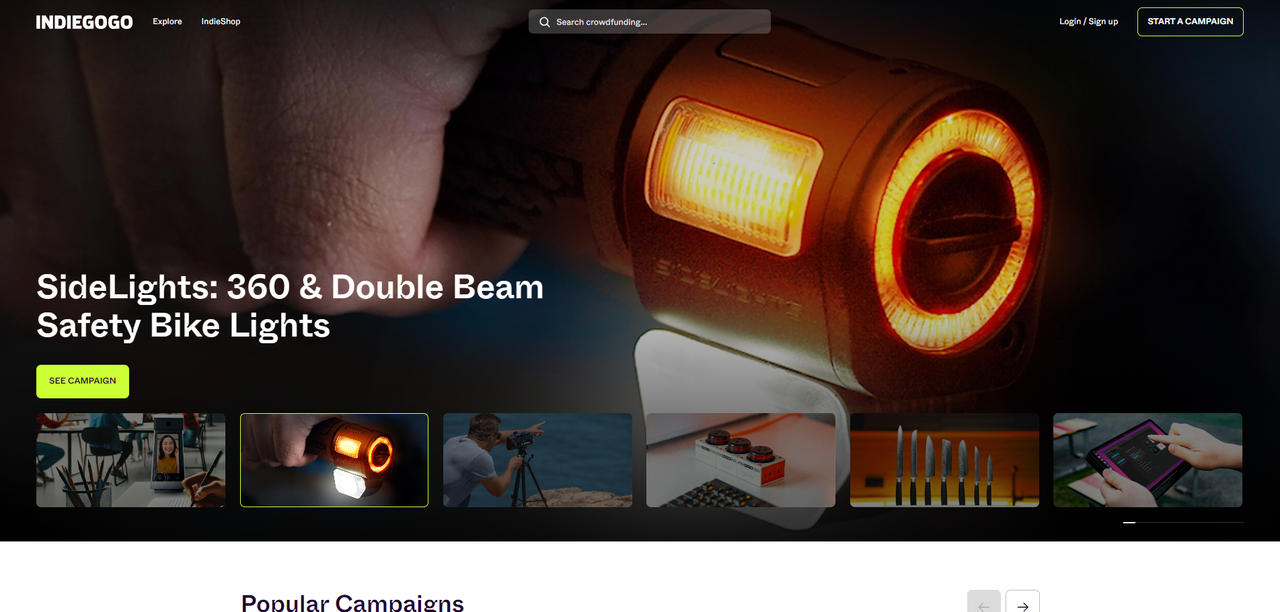
Here’s where creators usually feel the gap in practice—not theory.
Audience and traffic behavior
Kickstarter still benefits from a larger, more engaged backer community that actively browses and funds projects. Indiegogo traffic is smaller and tends to rely more on external marketing.
Conversion dynamics
Kickstarter creates urgency through all-or-nothing funding. Indiegogo tends to feel slower, more exploratory, and more dependent on your own promotion.
Campaign lifecycle
Kickstarter = launch spike + strong early momentum
Indiegogo = steadier, longer tail (especially if extended sales are used)
Category performance
Kickstarter: creative products, tabletop games, storytelling-driven ideas
Indiegogo: hardware, tech gadgets, experimental products
Trust perception
Kickstarter generally has stronger backer trust due to stricter project approval and visibility rules. Indiegogo is more open—but that openness can make backers more cautious in some niches.
Which Platform Fits Which Type of Creator?

This is where decisions usually become clearer.
Choose Kickstarter if:
You want fast validation, strong early momentum, and category-driven discovery. Especially if:
You’re launching a physical product or game
You already have some audience or mailing list
You need credibility for investors or retailers
Choose Indiegogo if:
You want flexibility and longer selling potential. Especially if:
Your product is early-stage or evolving
You plan to continue selling after crowdfunding ends
You want more control over campaign structure
Where Logistics Changes Everything (Often Ignored)
Here’s something most creators underestimate: fulfillment determines whether your campaign becomes a business or a headache.
Platforms help you raise money. But they don’t help you ship globally at scale.
This is where logistics partners like SendFromChina become critical.
When campaigns succeed, creators suddenly face:
Hundreds or thousands of international shipments
Customs complexity
Storage and batch fulfillment
Returns and damage handling
Rising shipping costs post-campaign hype
Kickstarter campaigns especially feel this pressure because demand spikes quickly and globally.
A structured third-party logistics system helps stabilize that transition from “viral campaign” → “real operation.”
So… Which One Is Right in 2026?
There’s no universal winner anymore.
But there is a practical rule:
If your success depends on visibility and urgency → Kickstarter
If your success depends on flexibility and extended sales → Indiegogo
In many real-world cases, creators even use both in sequence:
Kickstarter for launch momentum, then Indiegogo for continued sales.
That hybrid strategy has become more common as crowdfunding matures into a multi-stage product launch system rather than a single campaign moment.
Short Conclusion
In 2026, the difference between Indiegogo and Kickstarter is less about who is “better” and more about how your product is meant to grow.
Kickstarter amplifies launches. Indiegogo extends them.
The smartest choice depends on whether you need a spotlight—or a runway.
FAQs
Is Kickstarter more successful than Indiegogo?
Generally yes. Kickstarter reports higher success rates due to stricter project selection and stronger community demand.
Which platform is better for hardware products?
Indiegogo often performs better for hardware because of flexible funding and extended sales options.
Can I use both platforms?
Yes. Many creators launch on Kickstarter first, then move to Indiegogo for continued sales.
Do both platforms charge fees?
Yes. Both typically take platform and payment processing fees totaling around similar percentages.
Which platform is better for beginners?
Kickstarter is often better for beginners because of stronger built-in discovery and clearer structure.
 Post Views:3897
 TAGS:
TAGS:
Copyright statement: The copyright of this article belongs to the original author. Please indicate the source for reprinting.
Previous Post
Seasonal Inventory Management: The Complete Guide for Ecommerce Brands in 2026
Next Post
TAGS
Hot Research
Get Custom eCommerce Fulfillment Service
Book a Meeting
Get a Custom China Fulfillment Solution with FREE Storage for 30 Days
Want to know about our services, fees or receive a custom quote?
 Want to know about our services, fees or receive a custom quote?
Please fill out the form on the right and we will get back to you within a business day.
The more information you provide, the better our initial response will be.