




Table of Contents
Get Custom eCommerce Fulfillment Service
Book a Meeting
Right-Size Packaging: How to Reduce Dimensional Weight and Empty Space
Time: Sep 22,2026 Author: SFC Source: www.sendfromchina.com
A phone case arrives in a box made for a pair of shoes. Inside, three air pillows are doing their best to look useful. We have all opened a parcel like that.
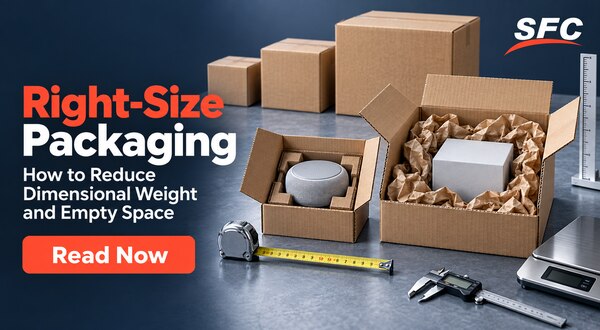
For an ecommerce brand, the joke is less funny. Carriers may charge for the space the parcel occupies, not only its scale weight. The brand also buys a bigger box, more filler, and slower packing.
Right-size packaging fixes this, but “use a smaller box” is incomplete advice. The real target is the smallest package that can protect the order through its actual shipping route. Small enough to control cost. Strong enough to arrive without drama.
Why Right-Size Packaging Is More Than Choosing a Smaller Box
Right-size packaging matches each order with an appropriate mailer, carton, insert, and seal. It starts with product data and ends with a pack the warehouse can reproduce.
A designer may create a fitted box for one SKU. A warehouse receives orders containing two sizes, a sample, and a gift card. Real baskets are messy.
Oversized packaging affects more than postage:
- A larger shipping cube can increase dimensional weight.
- More empty space usually needs more dunnage or void fill.
- Packers spend longer building and filling the parcel.
- Extra carton sizes consume warehouse slots and working capital.
- Products can move, collide, or reach the box wall during a drop.
- Customers see a wasteful unboxing experience.
Measure the finished parcel’s outside. Carriers do not bill from neat dimensions in a supplier spreadsheet. Tape, bulging mailers, and overfilled cartons change the final size.
So the rule is simple, though the work is not: choose the smallest safe package, not merely the smallest package.

Dimensional Weight: The Math Behind Shipping Empty Space
Three weights appear in packaging discussions:
- Actual weight is what the packed parcel weighs on a scale.
- Dimensional weight, also called DIM or volumetric weight, converts parcel volume into a weight value.
- Chargeable weight is the weight the carrier uses for pricing under its tariff. It is commonly the higher applicable value after rounding and service rules are applied.
The general calculation is:
Dimensional weight = Length × Width × Height ÷ DIM divisor
The units and divisor must match. A metric service may use 5,000, while an inch-based tariff may use 139. Do not treat either as universal. Carrier, route, service, account, and date can change the rule.
The UPS package dimensions and weight guide also shows why measurement details matter. Dimensions are taken at the longest points, and rounding can affect the billed result.
A Before-and-After Packaging Example
Imagine a product and its basic protection weigh 0.8 kg. The original carton measures 40 × 30 × 20 cm. A revised pack measures 30 × 22 × 12 cm.
Using 5,000 as an illustrative divisor:
| Packaging setup | Packed dimensions | Actual weight | Calculated volumetric weight | Illustrative chargeable weight |
| Oversized carton | 40 × 30 × 20 cm | 0.8 kg | 4.8 kg | 4.8 kg |
| Right-sized carton | 30 × 22 × 12 cm | 0.8 kg | 1.584 kg | About 1.6 kg after illustrative rounding |
The smaller carton cuts volume from 24,000 to 7,920 cubic centimeters. The product did not change. The brand simply stopped buying so much room around it.
The invoice will not necessarily fall by the same percentage. Rate bands, minimums, surcharges, and rounding still apply. Compare both parcels with the live route tariff.

Empty Space Is Not the Same as Protective Space
Some empty space is pointless. Some performs a job.
A T-shirt can sit close to a mailer wall. A glass bottle needs clearance for cushioning and separation from hard corners. A liquid may need a sealed inner bag. An irregular metal part may need blocking so one sharp edge cannot punch through the carton.
Functional space absorbs shock, resists compression, and controls movement. Unnecessary void is leftover volume. Shake the parcel, inspect contact points, and test the finished pack.
Stuffing more filler into a large box is not always safer. Think of shoes one size too big. Adding more tissue may stop your foot sliding for a while, but it does not create a well-fitted shoe. A closer carton with cushioning placed at the right points usually gives more controlled protection.
Judge the redesign with damage, reshipment, support, and replacement inventory included. A few cents saved on paper means little if damage rises.
A Seven-Step Right-Sizing Process for Ecommerce Orders
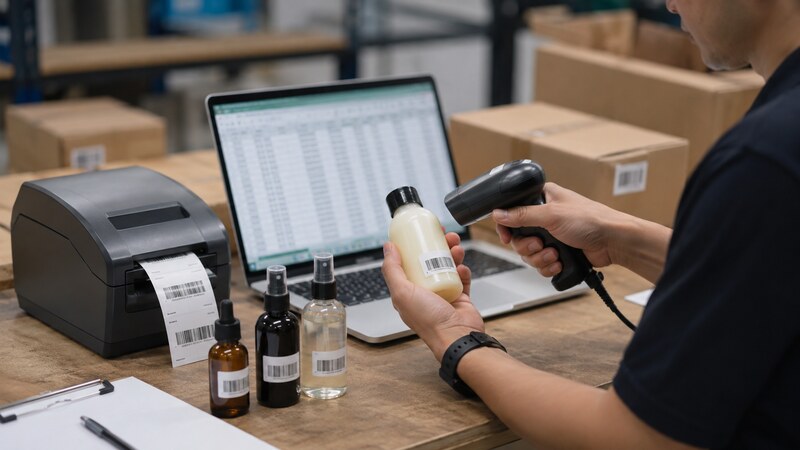
Capture Accurate Product and Packed Dimensions
Measure production samples with the retail box, accessories, manuals, and inner bag. Record dimensions, weight, orientation, nesting, fragility, leak risk, and crush limits.
Supplier data is a starting point. A cable beside a charger or a raised cap can change the required carton. Record bare and packed dimensions.
Analyze the Order Profile, Not Only Individual SKUs
Export several months of order lines. Group common baskets: one SKU, duplicate units, bundles, mixed orders, subscriptions, and gifts.
Start with combinations creating the most shipments or DIM cost. Do not perfect a box for an order that appears twice a year.
Build a Lean Carton and Mailer Library
One box for everything wastes space. Forty nearly identical boxes waste warehouse space and confuse packers. The useful answer sits between those extremes.
For each candidate size, check:
- Percentage of historical orders it can cover
- Average unused volume
- Maximum packed weight
- Material grade and protection level
- Packaging MOQ and replenishment time
- Storage slots at the packing station
- Risk of a packer choosing the wrong size
Mailers, variable wraps, and multi-depth boxes can cover several profiles without a giant catalog. Box-on-demand equipment may suit high volume or highly varied orders, but not every brand.
Match the Format to Product Risk
Soft goods may need a mailer. Books suit variable wraps. Cosmetics may need dividers and leak control. Electronics can require fixed accessories or corner clearance. Ceramics need tested cushioning.
Do not let a shipping-cost goal erase product requirements. A mailer is wonderfully compact right up to the moment a rigid product cracks through it.
Write Cartonization and Exception Rules
A packer should not have to guess. Define the smallest eligible pack for each SKU or order group, along with quantity and weight limits. Add rules for incompatible products, liquids, sharp edges, batteries, premium retail boxes, and items that must not be combined.
A WMS or bin-packing tool can recommend a carton for multi-item orders. It still needs guardrails: two items may fit mathematically but damage each other. Let trained operators override and record why.
Test the Finished Pack
Test the package with the real product inside. Depending on the risk and route, the plan may include drop, vibration, compression, puncture, seal, and humidity checks.
The ISTA test procedure library includes ISTA 3A for individual parcel-delivery shipments and ISTA 3L for generalized ecommerce retailer fulfillment. ASTM D4169 is another distribution-testing framework used in suitable programs. These are methods for building an appropriate test plan, not decorative badges for a product page.
A controlled shipping pilot catches warehouse and route issues too. Send representative orders to several destinations and inspect corners, surfaces, movement, seals, and carrier remeasurement.
Audit Cost and Failure Data
Compare more than the new carton price. Track:
- Packaging material cost per order
- Packing time
- Packed dimensions and actual weight
- DIM-to-actual-weight ratio
- Carrier adjustments
- Damage and reshipment rate
- Packaging stock usage and write-offs
Review results by order profile and destination. A design may win on an express route but change little on a differently priced postal service. Packaging optimization is not one big switch.
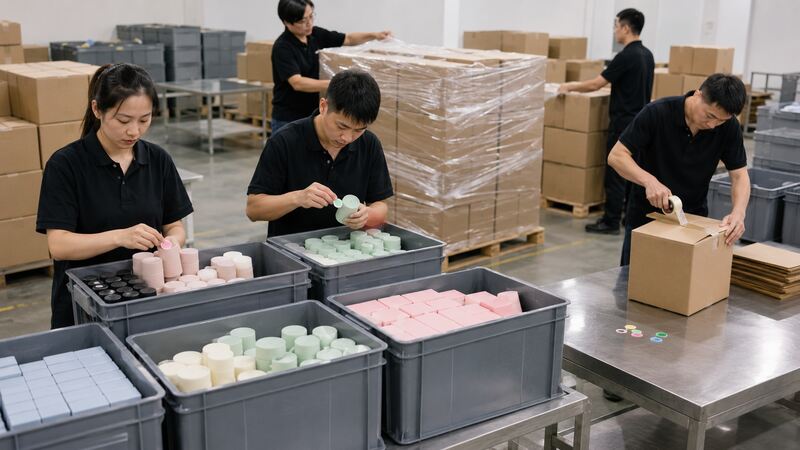
Packaging Formats and Materials That Reduce Empty Space
Formats remove space differently. A mailer wraps soft goods, a multi-depth carton cuts unused height, and a fitted insert controls movement without loose filler.
| Format | Best fit | Space-saving benefit | Protection limit | Warehouse consideration |
| Poly mailer | Apparel and soft goods | Very low thickness and weight | Little crush protection; puncture risk | Fast to pack, but size still matters |
| Paper mailer | Books, accessories, and flat goods | Folds closely around contents | Moisture, tear, and seam limits | Avoid overfilling |
| Corrugated carton | Fragile, heavy, or mixed orders | Many sizes and strength grades | Oversizing creates cube and filler waste | Control the carton library |
| Multi-depth carton | Orders with changing height | Reduces unused vertical space | Base footprint stays fixed | Give clear fold or cut rules |
| Book wrap | Books and flat retail boxes | Adjusts to several product thicknesses | Poor fit for irregular shapes | Efficient within its size range |
| Molded pulp or die-cut insert | Fragile or presentation-led products | Holds products with little loose fill | Tooling and SKU specificity | Control revisions and inventory |
| Honeycomb or paper cushioning | Fragile and heavier goods | Protects selected impact points | Overuse adds cube and labor | Standardize position and quantity |
Board grade, flute, tape, inserts, and filler work as one system. A thinner box is not cheaper if it needs extra tape and paper. Before going custom, compare ecommerce packing materials available at a China warehouse. A stock size may solve the problem without tooling or a large MOQ.
Right-Sizing for Different Products and Industries

Apparel and Soft Goods
Use a folding standard and choose a mailer that closes without stretching the seam. Remove trapped air before sealing. If the pack needs a return strip, leave room for the customer to open it without destroying the second seal.
Beauty, Cosmetics, and Liquids
Control caps, pumps, and glass-to-glass contact. Compact dividers can beat several loose wrapping layers. A fitted carton may still need leak containment.
Electronics and Accessories
Secure cables and adapters so they cannot scratch the device. Protect retail-box corners when presentation matters. Use anti-static materials where the product risk requires them, not as empty specification language.
Fragile Homeware and Ceramics
These products need clearance. The goal is not zero space; it is zero uncontrolled movement. Concentrate cushioning around impact zones, separate pieces, and test the weakest orientation.
Subscription Boxes, Bundles, and Board Games
Repeatable layouts speed packing, but seasonal products can break a fitted design. Keep an approved alternative. A useful branded packaging fulfillment system in China protects the order and fits shipping economics, not just a logo.

How a China 3PL Makes Right-Size Packaging Repeatable
Products made in China can be measured near the factory, matched with local packaging samples, and tested before global launch. That short loop still needs control.
Create a Packaging BOM and Pack Recipe
Give every mailer, carton, insert, and tape a packaging SKU and revision. Record orientation, filler quantity, seal, label position, weight limit, and exceptions.
Photos help. One physical “golden sample” at the packing station helps even more.
Receive and Control Packaging Inventory
Check incoming dimensions, damage, print version, board condition, and quantity. Set reorder points around lead time and peak demand. Retire obsolete stock before it reappears during a busy shift.
Connect Data to the Packing Station
The pack recommendation should flow into the wider China order fulfillment workflow. Product dimensions, order lines, packaging inventory, carrier rules, and pack instructions need to describe the same reality.
Rules can handle repeat orders. Complex or fragile baskets may need a visual prompt or human review. Record final weight and dimensions for invoice comparison.
When kitting, fitted inserts, relabeling, or custom presentation are involved, custom packaging and value-added services can turn the approved design into a controlled warehouse step.
Pilot Before Full Rollout
Pilot representative high-volume orders across several destinations, including one awkward basket. Compare total packaging cost, chargeable weight, packing time, and damage rate.
If chargeable weight falls but packing time doubles, try again. If the carton survives but looks half-crushed, customer perception still matters. Small annoyances grow at 5,000 orders a day.

Standards, Carrier Rules, and the EU Empty-Space Direction
These rules solve different problems:
- Carrier tariffs determine measurement, dimensional weight, rounding, oversize charges, and billable weight.
- ISTA and ASTM procedures help evaluate packed-product performance under selected distribution hazards.
- FEFCO codes describe common corrugated-box styles. A style code does not guarantee transit performance.
- Packaging law controls market access, waste, labeling, and other compliance duties.
For the EU, Regulation (EU) 2025/40 on packaging and packaging waste addresses empty space in Article 24. It sets a maximum 50% empty-space ratio for grouped, transport, and ecommerce packaging by January 1, 2030, or three years after the relevant implementing act enters into force, whichever is later.
The regulation treats filling materials such as paper cuttings, air cushions, bubble wrap, foam, and similar dunnage as empty space for this calculation. It also calls for a calculation methodology that considers product-protection needs, irregular shapes, multiple products, liquids, small items, and label space. Reusable packaging and sales packaging used as ecommerce packaging receive specific treatment.
This is not legal advice. Check the final implementing methodology, product exceptions, packaging category, and national obligations for each destination market.
Conclusion
Right-size packaging is a balance among shipping cube, product protection, pack speed, and repeatability. Start with the order combinations that create the most volume or the highest DIM charges. Measure real parcels, build a lean packaging range, test the finished pack, and give the warehouse clear rules.
Then review chargeable weight and damage together. Saving space is useful. Saving space without creating returns is the actual win.
FAQs
What is right-size packaging?
It is the process of matching an order with the smallest practical package that still protects it through storage, handling, and delivery. It includes the outer pack, inserts, cushioning, sealing method, and warehouse rules—not just box dimensions.
How do you calculate dimensional weight?
Multiply the parcel’s outside length, width, and height, then divide by the carrier’s applicable DIM divisor. Use matching units. Confirm the divisor, measurement method, and rounding rule for the specific service and account before estimating cost.
What is the difference between actual, dimensional, and chargeable weight?
Actual weight comes from the scale. Dimensional weight represents the parcel’s volume as a weight. Chargeable weight is the value used for pricing under the carrier’s rules, commonly the higher applicable weight after rounding.
Do FedEx, UPS, DHL, and postal carriers use the same DIM divisor?
No. Divisors and thresholds can vary by carrier, service, country, route, and contract. They may also change. Use the current tariff or rate tool for the shipment rather than assuming one formula works everywhere.
How much empty space should be left inside a shipping box?
There is no safe universal number. Soft goods need very little clearance. Fragile, sharp, liquid, or irregular products need functional space for blocking, cushioning, or containment. Base the allowance on packed-product testing and applicable market rules.
Can reducing box size increase product damage?
Yes, if the redesign removes necessary cushioning or places the product against an impact zone. A smaller box can also reduce movement and improve protection. Test the product-package combination instead of judging size alone.
Are mailers better than boxes for lowering dimensional weight?
They often are for apparel and other soft, non-fragile goods because they add little volume or weight. Rigid, sharp, premium, or fragile products may need a carton. The cheapest format is the one that controls shipping cost without increasing damage.
How many box sizes should an ecommerce business stock?
There is no magic count. Use order history to find a small set that covers frequent baskets with acceptable void space. Add a size only when its shipping or protection benefit is greater than its purchasing, storage, and packing complexity.
How does a 3PL choose the correct carton for a multi-item order?
A 3PL can use product dimensions, item compatibility, quantity, weight limits, packaging inventory, and cartonization rules. Software may recommend the smallest eligible pack, while trained operators handle fragile combinations and documented exceptions.
How can a brand measure savings from right-size packaging?
Compare old and new material cost, packing labor, packed dimensions, chargeable weight, carrier adjustments, damage, and reshipments over a representative order sample. Measure total cost per successful delivery, not only the price of the box.
 Post Views:14
 TAGS:
TAGS:
Copyright statement: The copyright of this article belongs to the original author. Please indicate the source for reprinting.
Previous Post
Next Post
Sustainable Ecommerce Packaging From China: Materials, Tradeoffs, and Costs
TAGS
Hot Research
Recent News
- Where Does Shein Ship From
- What Is Ecommerce Fulfillment? The Definition, Process, and Benefits
- Third Party Logistics Definition, Process, and Advantages
- Right-Size Packaging: How to Reduce Dimensional Weight and Empty Space
- Sustainable Ecommerce Packaging From China: Materials, Tradeoffs, and Costs
Get Custom eCommerce Fulfillment Service
Book a Meeting
Get a Custom China Fulfillment Solution with FREE Storage for 30 Days
Want to know about our services, fees or receive a custom quote?
 Want to know about our services, fees or receive a custom quote?
Please fill out the form on the right and we will get back to you within a business day.
The more information you provide, the better our initial response will be.