

Table of Contents

Get Custom eCommerce Fulfillment Service
Book a Meeting

Commercial Invoice for Ecommerce Shipping From China: Required Fields and Examples

Time: Oct 12,2026 Author: SFC Source: www.sendfromchina.com

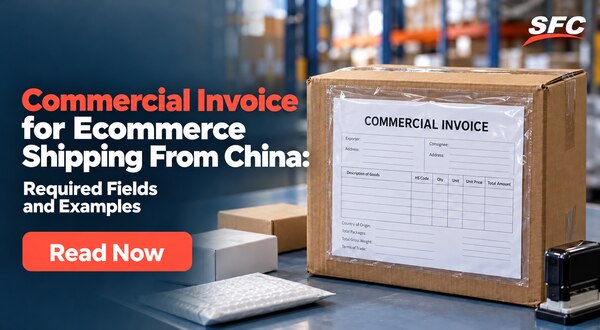
A parcel can be packed perfectly and still stop at customs because its paperwork tells a poor story.
commercial-invoice-ecommerce-from-china
Maybe the product description says “accessories.” Maybe the invoice lists China as the origin because the warehouse is in Shenzhen, even though the goods were made elsewhere. Maybe two free promotional items are inside the parcel but not on the invoice. Or the invoice says three units while the packing list says four.

 
To a customs reviewer, carrier, or broker, those are not tiny clerical details. They are unanswered questions about what is moving, who is involved, where the goods came from, and what value should be assessed.
 
A commercial invoice is the shipment's customs-facing identity card. It should explain the transaction and the goods clearly enough for the relevant parties to process the shipment. The exact form and additional requirements vary by destination, carrier, commodity, shipping mode, and transaction. Still, most reliable invoices are built from the same foundation:
 
Identify the parties -> Describe the goods -> Classify and state origin -> Declare value -> State the trade terms -> Reconcile the documents -> Submit and retain
 
This guide explains that process for ecommerce goods shipped from China. It also includes field examples, awkward non-sale scenarios, a fictional multi-item invoice, and a pre-dispatch checklist.
 

What Is a Commercial Invoice?

A commercial invoice is a transaction and customs document used for international shipments of goods. Customs authorities, brokers, carriers, buyers, and importers may use it to understand the parties, goods, values, origins, quantities, and trade terms associated with a shipment.
 
The U.S. International Trade Administration describes the commercial invoice as a document required by the buyer and used by customs authorities to assess duties and taxes. It also warns that countries can specify requirements for content, form, copies, language, and other details. That last part matters: there is no single universal PDF that is automatically correct everywhere. Official commercial invoice guidance should be read together with destination, carrier, broker, and product requirements.
 
For ecommerce brands using fulfillment in China, the invoice is often generated during label creation. But the warehouse should not invent the underlying data at the packing bench. The merchant, exporter, importer, supplier, and compliance advisers must establish the correct party, classification, origin, value, and trade-term information before orders begin moving.
 

Who Usually Prepares It?

The seller or exporter is normally responsible for providing accurate commercial information, even when a 3PL, carrier platform, freight forwarder, or broker creates the document from supplied data.
 
That distinction is important. Clicking “generate invoice” does not transfer responsibility for a vague description or unsupported country of origin. Automation can repeat good data at speed. It can also repeat one bad field across 5,000 parcels. Very efficient, just in the wrong direction.
 commercial-invoice-ecommerce-from-china
 

Commercial Invoice vs. Other Shipping Documents

These documents overlap, but they do different jobs.
 
Document
Primary purpose
What it does not replace
Commercial invoice
Identifies parties, goods, value, origin, and trade terms for the transaction and customs processing
Packing list, transport record, permits, or licenses
Pro forma invoice
Provides preliminary transaction or shipment information before a final invoice
Final commercial invoice when one is required
Packing list
Shows packages, packing breakdown, quantities, dimensions, and weights
Commercial values and full trade terms
Air waybill or bill of lading
Records the carrier movement or transport contract
Detailed commercial and customs information
Tax or sales invoice
Supports billing or domestic accounting requirements
Destination customs-document requirements
Customs declaration
Transmits data to customs through a postal, carrier, broker, or electronic process
Supporting commercial records and product evidence
 
The packing list answers, “How is it packed?” The commercial invoice answers, “What is it, who is trading it, where did it originate, and what is its value?” The air waybill answers, “How is the carrier moving it?”
 
One document should not contradict another. If the invoice shows two cartons and the carrier record shows one, someone will probably ask why.
 commercial-invoice-ecommerce-from-china
 

Who Appears on a Commercial Invoice?

Ecommerce shipments can involve more parties than the customer sees at checkout. A brand may be incorporated in the United States, store goods in Shenzhen, use a Chinese export entity, sell to a customer in France, and appoint another entity as importer.
 
Do not collapse those roles into whichever address is easiest to paste.
 

Seller and Exporter

The seller is the party selling the goods in the commercial transaction. The exporter is the party acting in the export process under the applicable setup. In a simple transaction they may be the same entity. In a marketplace, distributor, or managed-export arrangement, they may not be.
 
The pickup warehouse is not automatically the seller or exporter. A fulfillment center can physically ship the parcel without owning the goods or being the merchant on the transaction.
 

Buyer, Consignee, and Ship-To Contact

The buyer is the commercial purchaser. The consignee is the party to whom the goods are consigned or delivered under the shipment setup. The delivery contact may be an individual receiving the parcel at the consignee's address.
 
In a normal DTC order, these roles may point to the same customer. In B2B, marketplace, gift, or corporate purchasing scenarios, they may differ.
 

Importer of Record

The importer of record is the party responsible for the import entry and related obligations under the destination setup. It is not automatically the final customer, warehouse, or consignee.
 
Agree on this role before dispatch. An unclear importer arrangement can lead to customs delays, unexpected fees, or a carrier asking the recipient for information they never expected to provide.
 

Party-Role Example

Role
Illustrative ecommerce scenario
Seller
U.S.-registered brand operating the online store
Exporter
Approved Chinese export entity used for the shipment
Pickup location
Shenzhen fulfillment warehouse
Buyer
Customer who paid for the order
Consignee
Customer or business receiving the goods
Importer of record
Party agreed under the destination and duty-payment setup
Broker
Customs broker or carrier brokerage operation handling entry
 
The exact names and addresses should come from verified legal and order data, not from assumptions based on the parcel's route.
 commercial-invoice
 

Core Commercial Invoice Fields

The list below covers fields commonly expected across many international shipments. Destination authorities, carriers, brokers, buyers, commodities, and transport modes may require more.
 
Field
What to enter
Why it matters
Common error
Document title
“Commercial Invoice” or the required document title
Identifies the document's purpose
Using a payment receipt with missing customs data
Invoice number
A unique, traceable reference
Supports audit, corrections, and matching
Reusing one number across unrelated shipments
Invoice date
Date the invoice is issued
Establishes document timing
Date does not match the shipment workflow
Export or ship date
Planned or actual date where requested
Connects invoice to the movement
Missing or inconsistent date
Order and shipment references
Order, PO, shipment, tracking, or air-waybill references
Links systems and documents
References belong to another order
Seller/exporter details
Verified legal name, address, contact, and required identifiers
Identifies the commercial and export party
Using only a brand nickname or warehouse address
Buyer/consignee/importer details
Correct names, addresses, contacts, and identifiers by role
Supports delivery and import processing
Treating every role as the recipient
Reason for export
Sale, sample, replacement, repair, return, or another accurate reason
Explains transaction context
Writing “gift” to avoid duties when it is a sale
Incoterm and named place
Approved rule, named place, and version where used
Clarifies selected cost, risk, and delivery responsibilities
Writing only “DDP” or “DAP” without the named place
Currency
ISO-style currency reference such as USD or EUR
Makes values interpretable
Currency missing or mixed across lines
Product description
Specific commercial description for each line
Helps classification and admissibility review
“Parts,” “sample,” “gift,” or storefront title only
SKU/model/part number
Internal reference where useful
Links goods to catalog and records
Treating SKU as a substitute for a description
HS code
Reviewed classification at the level required for the lane
Supports tariff treatment and customs filing
Copying an old supplier code without review
Country of origin
Supported origin for each line
Used for tariff, marking, trade-measure, and other purposes
Using China merely because the warehouse is in China
Quantity and unit
Number and suitable unit of measure
Shows the amount of goods
Quantity differs from parcel contents
Unit value
Truthful value per unit under the approved valuation approach
Supports totals and customs review
Zero value for free goods without analysis
Line total
Quantity multiplied by unit value
Supports invoice arithmetic
Line total does not calculate correctly
Charges and adjustments
Freight, insurance, discounts, or other relevant amounts
Explains how the total is built
Freight included twice or discount omitted
Invoice total
Sum in the stated currency
Summarizes the transaction document
Total differs from line values and adjustments
Package and weight data
Package count, net weight, and gross weight where required or useful
Helps reconcile invoice, packing, and carrier data
Net weight is larger than gross weight
Declaration and signature
Approved statement, name, title, signature, or stamp where required
Certifies or completes the document under the applicable workflow
Assuming electronic submission removes every signature requirement
 
Carrier templates may request transport mode, ports, tax identifiers, export-control statements, license numbers, broker details, or other fields. Use the actual lane's instructions rather than treating this table as the last word.
 commercial-invoice
 

How to Write a Customs-Friendly Product Description

The product description should tell a trained reader what the goods actually are. A storefront title written to sell a product is often a poor customs description.
 
Use this practical structure:
 
Product type + material or composition + intended use + meaningful model or characteristics
 
Weak description
Stronger description
Accessories
Non-powered silicone protective cases for mobile phones
Clothes
Men's knitted cotton crew-neck T-shirts
Parts
Stainless steel replacement screws for household furniture
Sample
Two cotton canvas tote bags for product evaluation
Gift
Ceramic drinking mug, retail promotional item
 
The stronger version is not necessarily complete for every destination, but it gives customs and the broker something real to work with.
 

Description Words That Do Not Describe the Goods

Terms such as “sample,” “gift,” “warranty replacement,” “return,” and “not for resale” explain why the goods are moving. They do not explain what the goods are.
 
Instead of:
 
Warranty replacement
 
Use a description such as:
 
Replacement non-powered wireless-router housing made of ABS plastic; warranty shipment

 
The exact wording should match the real product and approved data. Do not add technical detail that is not true merely to make the line look impressive.
 commercial-invoice
 

HS Codes: What the Invoice Should Show

The Harmonized System provides an international six-digit foundation for classifying goods. Importing countries and customs unions often extend that structure with additional digits for their tariff schedules and reporting.
 
The code shown on the commercial invoice should align with:
 
  • The actual product.
  • Material or composition.
  • Function and intended use.
  • Construction and technical characteristics.
  • Destination classification requirements.
  • The description and supporting product records.

       
Some carrier forms request six digits. Some destination filings require a longer national code. Showing more digits is not automatically better if the code has not been reviewed for that destination.
 
Maintain approved classification data per SKU, including who reviewed it and when. If product design, material, or use changes, review the code again. Do not let a supplier's spreadsheet become permanent truth simply because it has been copied for two years.
 
When classification is uncertain, seek advice from the carrier, broker, customs professional, or relevant authority. This article does not assign a code to the examples below.
 commercial-invoice
 

Country of Origin Is Not the Shipping Country

Country of origin is a product-specific determination. It is commonly linked to where a product was manufactured or substantially transformed under the applicable origin rules. The correct analysis depends on the goods and the legal context.
 
A parcel leaving a Shenzhen warehouse may contain:
 
  • T-shirts manufactured in China.
  • Phone accessories manufactured in Vietnam.
  • Italian-made components previously imported into China.
  • A kit containing items with different origins.
 
The invoice may therefore need origin by line item.
 
Maintain supplier declarations, manufacturing records, bills of materials, purchase records, and other evidence that supports the declared origin. Warehouse location alone is not evidence of manufacture.
 
Also avoid blending several separate concepts. Product marking, non-preferential origin, and preferential origin under a trade agreement can involve different rules and evidence. A generic “Made in China” field does not settle every origin question.
 commercial-invoice
 

Declared Value for Ecommerce Orders

Value is one of the most sensitive invoice areas because the amount paid at checkout is not always the complete customs-valuation answer.
 
For ordinary sales, transaction information may include the price paid or payable, but freight, insurance, discounts, commissions, assists, royalties, related-party relationships, and other adjustments can require review under the applicable valuation rules.
 
Do not use a simple “lowest number possible” policy. Undervaluation can create penalties, delayed clearance, insurance problems, and poor audit records.
 

Normal Sales

Show truthful line-level unit values, quantities, totals, currency, and relevant charges or discounts. The invoice should reconcile with the order and payment data, subject to the approved customs-value treatment.
 

Samples and Free Promotional Goods

No customer charge does not automatically mean zero customs value. Describe the item itself, state the accurate reason for export, and use a supportable value under the approved approach.
 
“Sample - no commercial value” is not a magic phrase. The goods still exist, have a physical description, and may have a customs value.
 

Warranty Replacements

A customer may pay nothing for a replacement, but customs still needs to know what the product is and why it is moving. Link the shipment to the warranty case or original transaction where required and use the value treatment approved for the lane.
 

Returns and Repairs

Returned goods, temporary exports, repair shipments, and re-imports may need original shipment references, serial numbers, repair values, declarations, permits, or special procedures. Do not force them through an ordinary sale template.
 

Bundles, Kits, Free Gifts, and Multipacks

Account for every physical item. If an order includes a paid T-shirt and a free phone case, omitting the case creates a mismatch between documents and contents.
 
Whether a bundle can be shown as one line or should be split depends on classification, valuation, origin, product, and destination requirements. Build the approved treatment into the catalog rather than deciding differently on each order.
 

Discounts, Coupons, and Store Credit

Checkout payment, commercial invoice value, and customs value are not automatically identical in every scenario. Deep discounts, loyalty credit, related-party pricing, and unusual promotions may need review. Keep the discount visible and document the basis rather than silently changing the unit value.
 commercial-invoice
 

Incoterms, Freight, Insurance, Duties, and Taxes

Incoterms rules allocate selected delivery obligations, costs, and risks between buyer and seller. They do not classify the goods, determine origin, replace customs valuation, or make the commercial invoice optional.
 
When an Incoterm is used, show the approved rule with a named place and, where appropriate, the version. For example:
 
DAP, named delivery place, Incoterms 2020
 
That is more useful than writing only “DAP.”
 
DDP and DAP are common topics in ecommerce, but neither is universally better. The correct arrangement depends on the seller's registrations and capabilities, destination law, importer setup, carrier service, duties, taxes, customer promise, and total cost.
 
Freight, insurance, discounts, and other charges should be presented consistently with the transaction and destination requirements. The invoice total and the final customs value used by an authority may not always be identical.
 
When comparing the wider economics, include duties, taxes, brokerage, and fulfillment charges in the China fulfillment cost model, not only the parcel rate.


Completed Ecommerce Example From China

The example below shows how the fields can fit together. Every company, person, address, reference, value, and product detail is fictional.
 
Training example only. It is not a customs-ready invoice, classification decision, valuation instruction, origin ruling, or shipping quote. The HS codes are intentionally left for verification.
 

Header and Party Information

Field
Illustrative entry
Document
Commercial Invoice
Invoice number
CI-2026-10482
Invoice date
October 8, 2026
Order reference
WEB-784315
Shipment reference
SFC-DEMO-10482
Seller
Northstar Demo Brands LLC, fictional U.S. address
Exporter
Shenzhen Example Trading Co., Ltd., fictional Shenzhen address
Pickup location
Example Fulfillment Center, fictional Shenzhen address
Buyer/consignee
Jordan Example, fictional U.S. address
Importer of record
To be confirmed under the approved shipment setup
Reason for export
Sale
Currency
USD
Incoterm
DAP, fictional customer address, Incoterms 2020 - illustrative only
Package count
1 carton
Gross weight
1.10 kg
Net weight
0.72 kg
 

Product Lines

Line
Commercial description
SKU
HS code
Origin
Qty.
Unit value
Line total
1
Men's knitted cotton crew-neck T-shirts
TS-COT-01
Classification to be verified
China - illustrative
2 pcs
USD 14.00
USD 28.00
2
Non-powered silicone protective cases for mobile phones
PC-SIL-02
Classification to be verified
Vietnam - illustrative
2 pcs
USD 5.00
USD 10.00
 

Totals

Amount
Illustrative value
Merchandise subtotal
USD 38.00
Discount
USD 3.00
Freight shown separately
USD 7.00
Insurance
USD 0.00
Invoice total
USD 42.00
 
The arithmetic is consistent: USD 38.00 minus USD 3.00 plus USD 7.00 equals USD 42.00.
 
That consistency does not prove the customs value is correct. The approved valuation approach must still consider the destination rules and transaction facts. The example also does not decide whether freight should be included in or excluded from the destination customs value.
 

Why This Example Is Better Than a Store Receipt

It identifies the parties, export reason, currency, trade term, packages, weights, goods, origins, quantities, values, and references. It also avoids pretending that an unverified classification is known.
 
Before a real shipment, the merchant, exporter, carrier, broker, or qualified adviser would need to confirm the missing and lane-specific information.


Commercial Invoice Examples for Non-Sale Shipments

Non-sale does not mean no documentation. It means the transaction context differs.
 
Scenario
Reason for export
What changes on the invoice
Possible additional records
Product sample
Sample or evaluation
Truthful goods description and supportable value despite no normal sale
Sample request, test purpose, permit where applicable
Warranty replacement
Link to original order or case and approved value treatment
Warranty case, original invoice, serial records
Returned goods
Return
Identify original shipment and reason for return
Original export/import documents, RMA, proof of export
Repair shipment
Repair or temporary movement
Describe the goods and repair context accurately
Serial, repair authorization, temporary import/export records
Promotional item
Promotion
List the physical product and supportable value
Campaign or order reference
 
Avoid using a generic statement on every parcel. A warranty replacement, a return for repair, and a free marketing item are three different events.


Commercial Invoice, Packing List, Label, and Shipment Must Match

FedEx advises that international shipping documents should be consistent. That principle is useful well beyond one carrier: the invoice, packing list, electronic customs record, transport document, order, and physical parcel should tell the same material story. FedEx customs-document guidance can help teams understand the carrier-document workflow.
 
Data point
Commercial invoice
Packing list
Label / AWB
Physical shipment
Parties
Full commercial and customs roles
Often exporter and consignee
Shipper and delivery details
Parcel follows the shown route
Package count
Shown where required or useful
Detailed package breakdown
Carrier package count
Actual number of packages
Goods
Line-level commercial descriptions
Contents by package
Short shipment description or electronic data
Actual products inside
Quantity
Quantity by invoice line
Quantity by package
May appear in electronic customs data
Counted physical units
Weight
Net and gross where required
Package-level weights
Billable and actual shipping data
Measured shipment weight
Value and currency
Unit, line, charges, and total
Usually not the primary value document
Electronic declaration may repeat value
Goods support the declared transaction
Origin
By product line where needed
May repeat origin
Customs data may repeat origin
Supported by product records
References
Invoice, order, shipment, and tracking
Invoice or shipment reference
Tracking or air-waybill number
Labels attached to the correct parcel
 
Small format differences are normal. Material contradictions are not.
 

Common Reconciliation Failures

  • A free item is packed but not invoiced.
  • The invoice contains the full order, but the order was split into two parcels.
  • The label shows the customer's old address.
  • The packing list contains four units while the invoice contains three.
  • The invoice uses one currency, but the electronic customs record uses another.
  • Weight is estimated in the catalog but never replaced with packed weight.
  • A product substitution changes the SKU but not the invoice description.
 
Use the packing and customization workflow to connect the actual pack-out with invoice and customs data. If the physical parcel changes, the final documents may also need to change.


Paper Copies vs. Electronic Commercial Invoices

Many carriers support paperless invoice or electronic trade-document services on eligible lanes. Electronic submission can reduce printing, manual attachment, and missing-document problems.
 
It does not remove the need for complete, accurate invoice data.
 
UPS commercial invoice guidance explains both general invoice fields and paperless invoice options. Actual eligibility can depend on origin, destination, service, account enrollment, shipment type, and document requirements.
 
Before dispatch, confirm:
 
  • Whether the lane supports electronic invoice submission.
  • Whether the shipper's carrier account is enrolled.
  • Which documents are transmitted electronically.
  • Whether printed copies are still required as a fallback.
  • Whether originals, signatures, stamps, permits, or certificates must travel with the shipment.
  • How the warehouse knows the electronic upload succeeded.
  • What happens if electronic transmission fails after the label is created.
 
A paperless flag in software is not proof that customs received a complete document. Build an error and fallback process.


Product Categories That Need Extra Data or Documents

A basic commercial invoice is not a substitute for commodity-specific compliance.
 

Apparel and Textiles

Descriptions may need details such as garment type, fiber composition, knit or woven construction, gender or age category, and intended use. Textile labeling, origin marking, quota, permit, or statistical requirements may vary by destination.
 
“Cotton clothing” is usually less useful than “women's woven cotton trousers,” assuming that wording is true.
 

Electronics and Batteries

Identify the actual product function, model, power source, and battery relationship. Some shipments may need safety data, test summaries, transport declarations, permits, export-control review, or destination approvals.
 
Do not describe a power bank as a “phone accessory” and hope the carrier works out the battery details later.
 

Cosmetics, Food, Medical, and Regulated Goods

These products can trigger agency requirements beyond ordinary customs clearance. Ingredients, intended use, registration, permits, importer details, batch, expiry, labeling, and certificates may be relevant.
 
The commercial invoice remains important, but it is only one piece of the file.
 

Wood, Plant, Animal, and Natural Materials

Species, treatment, source, CITES status, phytosanitary documents, fumigation, or other declarations may apply. Generic descriptions such as “wood decor” or “leather accessory” can hide information needed for admissibility review.
 

Samples, Gifts, Repairs, and Returns

The export reason should be accurate, but the goods still need a real description, origin, quantity, and supportable value. Original shipment references and special customs procedures may also be needed.


A Reliable Invoice Workflow for a China Fulfillment Center

A commercial invoice should be the output of controlled data, not freehand typing.
 

1. Maintain Approved Customs Data Per SKU

Store:
 
  • Commercial description.
  • Material or composition.
  • Intended use.
  • Model or part number.
  • Reviewed HS code by relevant market where needed.
  • Supported country of origin.
  • Unit of measure.
  • Product weight.
  • Value rules and escalation flags.
  • Product-specific documents or restrictions.
 
During receiving at a China warehouse, verify that the physical SKU and supplier records match the approved product data. A supplier changing material or factory can affect more than purchasing.
 

2. Capture Legal Party and Import Data Per Order

The ecommerce platform or OMS should provide the verified buyer, consignee, ship-to contact, tax identifiers, importer setup, and other required data. Do not rely on warehouse staff to guess whether the customer is also the importer.
 

3. Apply the Approved Shipment Context

Map reason for export, Incoterm, named place, duty payer, seller, exporter, currency, and document template based on the order and lane.
 

4. Generate Line-Level Invoice Data

The order fulfillment process should pull product and order data into the invoice at order release or label creation. Split shipments and substitutions must generate updated line and package records.
 

5. Reconcile Before Carrier Handoff

Compare:
 
  • Order lines.
  • Picked and packed units.
  • Commercial invoice.
  • Packing list.
  • Shipping label or air waybill.
  • Electronic customs data.
  • Package count and weights.
 
Block dispatch when critical fields disagree.
 

6. Submit Through the Correct Workflow

Use the lane's approved paperless or printed process. Confirm uploads, signatures, copies, and supporting documents.
 

7. Retain the Final Version and Corrections

Store the final invoice linked to the order and tracking number. Keep revisions, correction requests, carrier or broker messages, and the approved resolution according to the brand's retention policy and applicable requirements.
 
Use API integration to synchronize product, order, carrier, and customs-document data where practical. Also retain error logs. A silent failed field is worse than a visible exception.


Common Commercial Invoice Mistake

commercial-invoice

Vague Product Descriptions

“Accessories,” “parts,” and “sample” do not tell customs what the product is. Use a truthful commercial description with useful material, function, and product details.
 

Storefront Titles Copied Into Customs Fields

“UltraFlex Pro Max Everyday Essential” may sell well. It says almost nothing about the goods. Maintain a separate customs-friendly description.
 

HS Code Copied Without Review

A supplier code can be outdated, incomplete, or wrong for the destination. Assign review ownership and record the source.
 

Shipping Country Used as Origin

Goods stored in China are not automatically Chinese-origin. Support origin at the product-line level.
 

Zero Value for Free Goods

Samples, gifts, promotions, and warranty replacements can still require a supportable customs value. Free to the customer is not the same as valueless.
 

Party Roles Confused

The buyer, consignee, importer, seller, exporter, and warehouse can be different. Identify each actual role instead of repeating one address.
 

Incoterm Without a Named Place

 
“DDP” or “DAP” alone is incomplete operationally. Use the approved named place and version where applicable.
 

Arithmetic and Currency Errors

Unit values, quantities, line totals, charges, discounts, and invoice totals should calculate. State one clear currency and handle conversions under the approved process.
 

Missing Free Gifts or Inserts

Every physical product should be accounted for. A promotional mug is still a ceramic mug inside the parcel.
 

Invoice and Parcel Do Not Match

Substitutions, split shipments, repacking, and late order changes can create mismatches. Generate or validate the final invoice after the final pack-out data is known.
 

Wrong Paperless Assumption

Electronic invoice support varies. Confirm the lane and account setup instead of removing paper copies because the software displays a checkbox.


3PL and System Requirements to Define

When outsourcing invoice generation, define who owns each field and exception.
 
Requirement
Questions to define
Product master
Which customs fields are mandatory before receiving or fulfillment?
Data approval
Who can approve or edit HS code, origin, value logic, and description?
Party mapping
Which entities populate seller, exporter, buyer, consignee, and importer fields?
Invoice numbering
How are unique numbers created, revised, and retained?
Templates
Which carrier, country, entity, mode, and sales-model templates apply?
Value logic
How are discounts, freight, insurance, free items, bundles, and replacements handled?
Incoterms
Who selects the rule, named place, duty payer, and broker setup?
Pack reconciliation
How are final quantities, packages, and weights checked?
Electronic documents
Which lanes are enabled, and what is the printed fallback?
Error handling
What blocks dispatch, and who resolves the exception?
Post-dispatch correction
Who contacts the carrier or broker, and how is the revised version recorded?
Reporting
Which errors, holds, corrections, and clearance outcomes are reported?
 
The 3PL can provide systems and process discipline. The merchant must provide truthful commercial and product data, plus clear escalation contacts.


Final Pre-Dispatch Checklist

  • Correct seller, exporter, buyer, consignee, importer, and delivery roles used.
  • Verified legal names, addresses, contacts, and required identifiers included.
  • Unique invoice number and correct issue date shown.
  • Order, shipment, tracking, or air-waybill references match.
  • Reason for export is accurate.
  • Approved Incoterm, named place, and version shown where applicable.
  • Currency is clear and consistent.
  • Every physical product appears on an invoice line.
  • Product descriptions explain type, material, use, and relevant characteristics.
  • HS codes have been reviewed for the relevant lane.
  • Country of origin is supported for each line.
  • Quantities and units of measure match the parcel.
  • Unit values, line totals, charges, discounts, and invoice total calculate.
  • Package count, net weight, and gross weight are consistent.
  • Product-specific identifiers, licenses, statements, or certificates are attached where required.
  • Invoice, packing list, label, electronic customs data, and physical contents agree.
  • Correct paperless or printed submission process confirmed.
  • Final document and any revisions retained.
       

Conclusion

A reliable commercial invoice is not a decorative PDF added after the carton is sealed. It is the customs-facing output of controlled product, party, value, origin, and transaction data.
 
The best workflow starts before the order. Maintain approved commercial descriptions, classifications, origins, units, and document rules per SKU. Capture the correct buyer, consignee, importer, and ship-to data. Apply the approved export reason and trade terms. Then reconcile the invoice with the packing list, label, electronic customs data, and physical contents before carrier handoff.
 
The seller remains responsible for truthful, supportable information even when a supplier, warehouse, carrier, platform, or broker helps prepare the document. If a field is uncertain, stop and verify it. A short review before dispatch is usually cheaper than a correction after the parcel reaches customs.
 
If you want to review how product data, packing, carrier labels, and commercial invoices connect inside a China fulfillment operation, you can request a fulfillment and shipping review.


FAQs

1. Is a commercial invoice required for every shipment from China?

Not every movement uses the same document set. International commodity shipments commonly require a commercial invoice or equivalent customs information, but postal shipments, documents, personal effects, low-value programs, returns, and special procedures can differ. Confirm the destination, carrier, service, commodity, and transaction requirements.
 

2. Who should issue the commercial invoice when a 3PL ships the parcel?

The invoice should reflect the correct seller and exporter setup. A 3PL may generate the document from approved data, but the merchant and relevant trade parties remain responsible for supplying truthful party, product, value, origin, and transaction information.
 

3. What is the difference between a commercial invoice and a packing list?

A commercial invoice shows the transaction, parties, goods, values, origins, and trade terms used for customs and commercial processing. A packing list focuses on how the goods are packed, including packages, quantities, dimensions, and weights. One does not automatically replace the other.
 

4. Can the commercial invoice value be zero for a sample or warranty replacement?

Do not assume so. A customer may pay nothing, but the goods can still require a supportable customs value. State the real goods, accurate reason for export, and value treatment approved for the destination and transaction.
 

5. How detailed should the product description be?

It should clearly identify the product using useful details such as product type, material or composition, intended use, model, and meaningful characteristics. Avoid vague terms such as “parts,” “accessories,” “gift,” or “sample” as the only description.
 

6. Does a commercial invoice need an HS code?

Many carriers, brokers, and customs processes expect HS classification data, but the number of digits and exact requirement vary by destination and filing method. Maintain reviewed classification data per SKU and verify the destination-specific code when necessary.
 

7. Is country of origin always China when shipping from China?

No. Shipping country and product origin are different concepts. Goods can leave a China warehouse while originating in another country. Determine and support origin for each product under the applicable rules.
 

8. How many copies of a commercial invoice are needed?

The number depends on the destination, carrier, service, document workflow, and whether electronic trade documents are accepted. Some shipments use paperless submission, while others require printed copies or originals. Follow the actual lane instructions.
 

9. Can a commercial invoice be submitted electronically?

Often yes, when the carrier, service, origin, destination, account, and document type support electronic trade documents. Electronic transmission changes how the document is submitted, not the need for accurate and complete data. Keep a fallback process for failed or unsupported submissions.
 

10. What happens if the commercial invoice does not match the shipping label or parcel?

The carrier, broker, or customs authority may request clarification, correction, inspection, additional documents, or payment. The parcel may be delayed, returned, revalued, or subject to other action. Reconcile the documents and physical contents before dispatch.
Post views Post Views:60

Get a Custom China Fulfillment Solution with FREE Storage for 30 Days

Want to know about our services, fees or receive a custom quote?

Please fill out the form on the right and we will get back to you within a business day.

The more information you provide, the better our initial response will be.

  • *

  • *

  • *

  • *

  • *
    Major destinations:

  • *

  • *

  • *

  • * Verification code